
Mastodon Pressed Actual Ice Age Fossils Into Vinyl. But Can You Play It?
Mastodon has pressed actual prehistoric fossils into a limited-edition vinyl record. Only 170 copies exist, but can a record containing powdered fossilized teeth actually sound good? We explore the unusual manufacturing process.
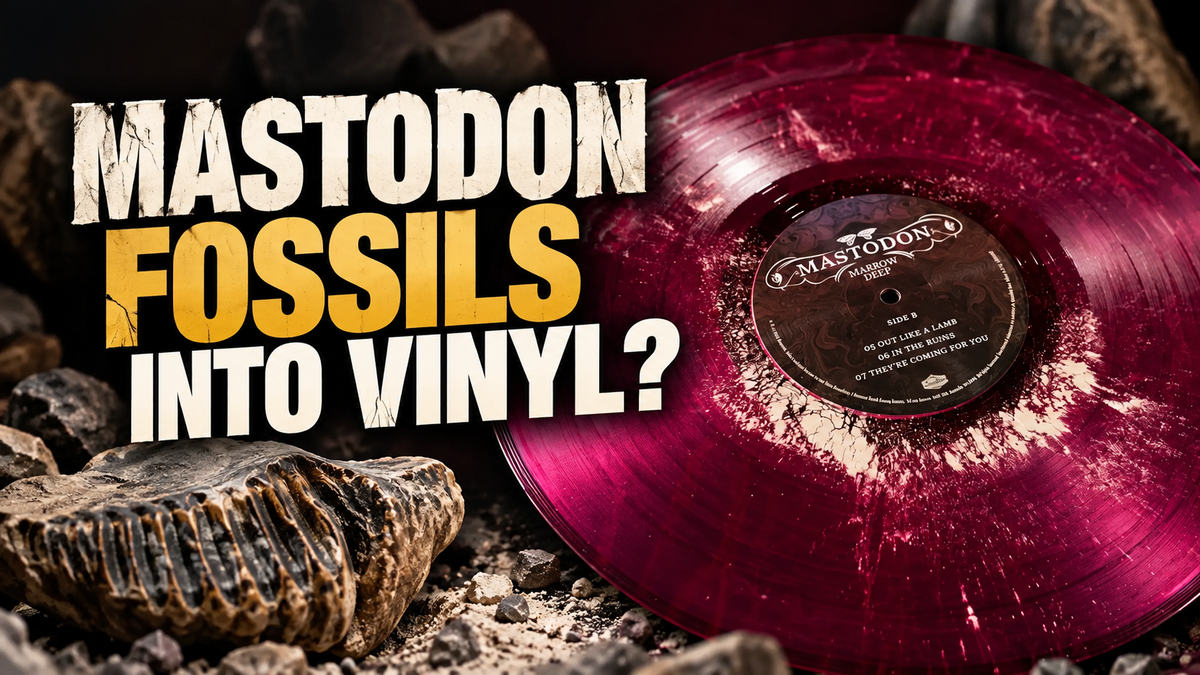
The metal band's latest collectible contains powdered prehistoric teeth. It's a remarkable idea, but it also raises an interesting question about how vinyl records are made.
Vinyl collectors have seen just about everything pressed into records. We've had unusual colors, elaborate splatter patterns, and increasingly creative limited editions.
But actual prehistoric fossils?
That's a new one.
Metal band Mastodon has announced an extraordinary edition of its latest album, Marrow Deep, containing powdered fossilized teeth from the prehistoric animal that inspired the band's name.
Only 170 copies exist, and each costs $150.
But the most interesting part isn't the price or the scarcity. It's how the band managed to incorporate thousands-of-years-old fossil material into a record that's supposed to be played with a delicate stylus.
A Bag of Fossils That Sat Around for 20 Years
The story begins approximately two decades ago, when a fan gave Mastodon a collection of fossilized mastodon teeth.
These weren't museum-quality specimens suitable for display. They were fragments that the band kept without knowing quite what to do with them.
Eventually, bassist and vocalist Troy Sanders came up with an unusual idea: grind the fossils into powder and incorporate them into a vinyl record.
With the band's new album titled Marrow Deep, the concept suddenly seemed especially appropriate.
According to the band's announcement, Loma Vista Recordings worked with Waxworks Records to make the project happen, while the University of Georgia's geology department helped prepare the fossil material.
The result is the Marrow Deep: Bone Dust Edition, a two-LP release containing actual prehistoric material.
And unlike a decorative fossil included in the packaging, the bone dust was incorporated into the records themselves.
How Do You Press Fossils Into Vinyl?
This is where the story becomes particularly interesting for anyone who cares about record manufacturing.
A conventional vinyl record is pressed from heated PVC compound. The material must flow into the extremely fine details of a metal stamper, reproducing the microscopic groove modulations that eventually become music.
Introducing foreign particles into that process presents an obvious challenge.
If those particles are too large, unevenly distributed, or positioned near the groove surface, they could potentially interfere with groove formation or playback.
That's why the preparation of the fossil material matters.
According to reports about the project, the University of Georgia's geology department helped grind the fossilized teeth into sufficiently fine particles, with the intention of preserving playability and sound quality.
Mastodon also participated directly in manufacturing the records, hand-sprinkling the prepared fossil dust during the pressing process.
The band has shared behind-the-scenes footage showing how the unusual edition was produced.
History that goes Marrow Deep - video from Mastodon's official website.
It's an ingenious combination of geology, music, and record manufacturing.
But it also leads to an important question.
Can a Record Containing Fossils Actually Sound Good?
The short answer is that it could. But we shouldn't confuse a successful manufacturing experiment with proof of identical playback performance.
Vinyl records already contain ingredients beyond PVC, including stabilizers, lubricants, and pigments. Different formulations can influence how the compound behaves during manufacturing.
Adding powdered fossil material is a different proposition, particularly when it isn't a conventional ingredient engineered for record production.
The critical factors would include particle size, distribution, concentration, and whether any material reaches the groove surface.
The project was reportedly designed to keep the particles fine enough to avoid affecting playback.
That's encouraging, but I haven't seen independent measurements comparing the Bone Dust Edition with a conventional pressing of Marrow Deep.
Without that comparison, there's no basis for claiming the fossil edition sounds better, worse, or exactly the same.
A useful test would involve playing both editions with a properly aligned cartridge, matching playback levels, and comparing surface noise, audible distortion, and the condition of the stylus after playback.
For a record limited to 170 copies, though, I suspect relatively few owners will be volunteering theirs for repeated testing.
And that brings us to the other side of this story.
A $150 Record You Have to Win the Right to Buy
The Bone Dust Edition is limited to just 170 copies, reportedly because of the finite quantity of fossil material available.
Each copy costs $150 and includes a certificate of authenticity.
Rather than making the records available through a conventional first-come, first-served sale, the label established a random drawing for the opportunity to purchase one.
The registration period was scheduled to close on October 12 at noon Eastern, with selected buyers charged for their copies and shipping expected around October 16.
Importantly, this isn't a giveaway. Winning the drawing means earning the opportunity to spend $150 on the record.
It's an interesting approach to a release that would otherwise likely sell out almost immediately.
And unlike the recent Duran Duran golden ticket promotion, where a random collector can win an entire vinyl discography, Mastodon's drawing determines who gets to purchase an unusually manufactured record.
Both releases demonstrate how labels are experimenting with the experience of collecting vinyl, but Mastodon's edition adds a genuine manufacturing experiment to the equation.
When the Record Becomes Part of the Artwork
There's something wonderfully appropriate about a band called Mastodon putting actual mastodon fossils into its music.
The concept isn't simply a random collectible gimmick. It connects the band's identity, the album's title, and the physical record itself.
That's what makes this release more interesting than another limited-color pressing.
The fossil material has a story. The manufacturing required an unusual collaboration. And the finished record is arguably as much an artifact as it is an audio format.
Still, I keep coming back to the same question.
If you owned one of these 170 copies, would you actually play it?
For me, a record's primary purpose is still to reproduce music. I'd be fascinated to hear how this pressing compares with the standard edition, particularly whether the added material introduces any measurable or audible differences.
But I also understand why someone might prefer to preserve a record containing genuine prehistoric fossils.
After all, it's not every day you can place something thousands of years old on your turntable.
Would you play a vinyl record containing actual fossils, or would you keep it sealed as a collector's item? Let me know in the comments.
Sources
- Official Mastodon Bone Dust Edition announcement and raffle details: https://i.mastodonrocks.com/bonedust
- Stereogum — Mastodon Announce Vinyl Pressed With Mastodon Fossils: https://stereogum.com/2514174/mastodon-announce-vinyl-pressed-with-mastodon-fossils/news
- Blabbermouth — Mastodon Details Limited Marrow Deep Vinyl Containing Actual Mastodon Fossils: https://blabbermouth.net/news/mastodon-details-limited-marrow-deep-vinyl-containing-actual-mastodon-fossils

Comments ()