
Did the Vinyl Boom Build Too Many Pressing Plants?
Vinyl sales are still growing, but pressing plants are closing. Did the vinyl boom create more manufacturing capacity than the market can sustain?
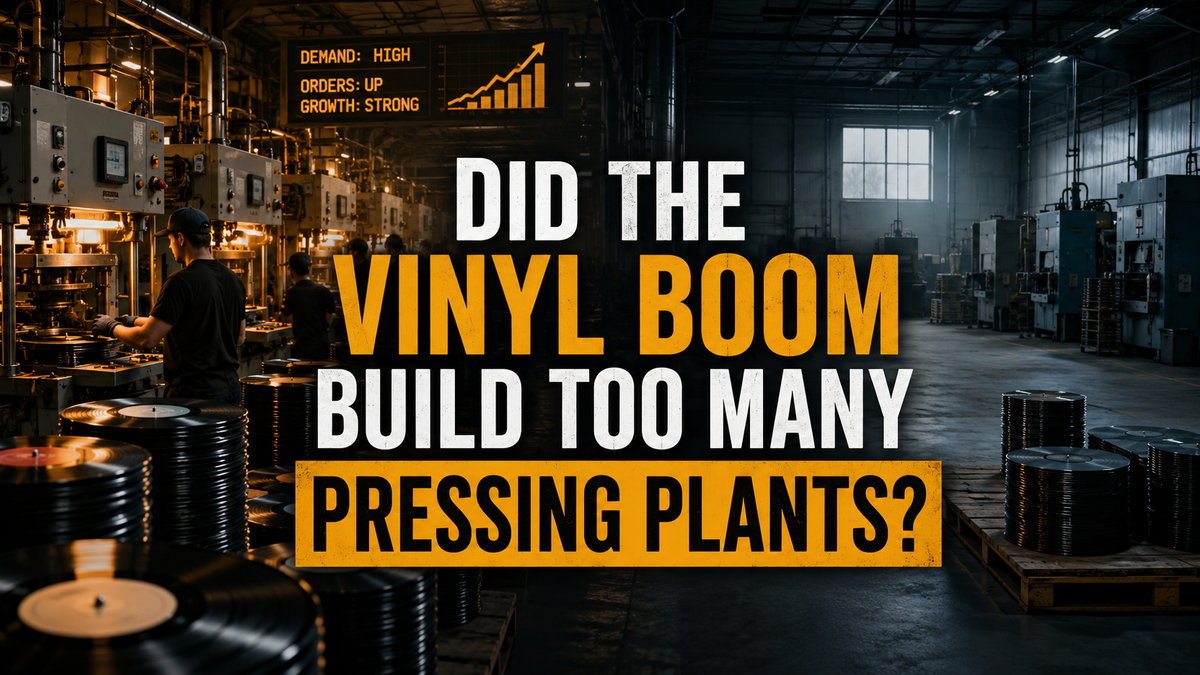
A few years ago, getting a record pressed could feel like trying to book a table at the hottest restaurant in town.
Everybody wanted in, there wasn't enough capacity, and the wait could stretch for months.
Artists delayed vinyl releases. Independent labels struggled to get manufacturing slots. Major releases consumed huge amounts of pressing capacity. During the pandemic fueled vinyl surge, the industry's manufacturing infrastructure simply could not keep up.
In 2022, Jack White publicly called on the major labels to invest in their own pressing plants, arguing that the bottleneck had become bad for the entire vinyl ecosystem. At the time, it made perfect sense. Demand was exploding, and supply was the problem.
The industry listened.
New plants opened. Existing manufacturers expanded. New presses entered the market. Production became increasingly automated.
Now, only a few years later, we may have the opposite problem.
Vinyl sales are still growing.
But some pressing plants are closing.
And according to people actually manufacturing records, vinyl production capacity may now exceed demand.
So did the vinyl revival solve its biggest manufacturing problem a little too well?
We Went From Too Few Presses to More Than 200 Manufacturers
The transformation has been remarkable.
When the vinyl resurgence began gaining momentum, manufacturing infrastructure was one of the industry's biggest weaknesses.
In 2014, there were only around 20 operating vinyl pressing plants in the United States. Many relied on decades old equipment, replacement parts were difficult to find, skilled technicians were scarce, and plants frequently operated nearly around the clock just trying to satisfy demand.
Then vinyl exploded.
By the pandemic, the problem had become impossible to ignore. Labels wanted records. Artists wanted records. Consumers wanted records.
There simply were not enough places making them.
So companies invested.
According to Nashville Public Radio, there were only 32 vinyl manufacturers worldwide roughly a decade ago.
By early 2025, there were more than 200.
That is an extraordinary increase.
United Record Pressing expanded.
GZ Media, already the world's largest vinyl manufacturer, opened Nashville Record Pressing.
Smaller independent operations launched across the country.
New pressing equipment from companies like Viryl Technologies and Pheenix Alpha made opening a modern plant more realistic than trying to rebuild machines manufactured half a century ago.
For several years, adding all that capacity looked like exactly what vinyl needed.
Then the math started changing.
For the First Time in Decades, Supply Caught Demand
Nashville's Vinyl Lab opened in 2021, right in the middle of the manufacturing boom.
Business initially came easily.
Owner Scott LeMasters told Nashville Public Radio that customers essentially found them. Demand was so strong that the company did not need to work particularly hard to generate orders.
Four years later, The Vinyl Lab was gone.
The plant closed in January 2025 after experiencing increasingly difficult competition and declining orders. It had pressed records for artists including Dolly Parton, Lucinda Williams, and Old Crow Medicine Show.
The reason LeMasters gave is what should make the vinyl industry pay attention.
According to the report, vinyl manufacturing supply had begun exceeding demand for the first time in roughly 20 years.
LeMasters said other independent plants were experiencing similar pressures, with some reporting business down dramatically compared with 18 months to two years earlier. United Record Pressing CEO Mark Michaels offered an equally sobering assessment, saying many plants were struggling and suggesting the industry was unlikely to sustain more than 200 manufacturers indefinitely.
That is a remarkable reversal.
Only a few years earlier, the conversation was:
How do we possibly press enough records?
Now the question may be:
How many pressing plants does the vinyl industry actually need?
And Now Another Pressing Plant Has Closed
That question became relevant again this summer.
Cascade Record Pressing, which opened near Portland in 2015, closed its doors in June after roughly 11 years in business.
I want to be careful here.
Cascade's closure by itself does not prove there is a national vinyl manufacturing crisis, nor should we assume every pressing plant that closes does so for the same reasons.
In fact, what happened next makes the story even more interesting.
Just as Cascade closed, Object Permanence Records opened in Salem, becoming Oregon's only operating record manufacturer. The company is positioning itself around independent musicians and smaller physical releases.
So this isn't simply a story about pressing plants disappearing.
One plant closes.
Another opens.
Large manufacturers continue producing millions of records.
Small manufacturers search for niches where they can compete.
That looks less like the death of vinyl manufacturing and more like a market entering a new phase.
Vinyl Is Still Growing. Just Much More Slowly.
That distinction matters because vinyl itself isn't collapsing.
U.S. vinyl revenue passed $1 billion in 2025, marking the format's 19th consecutive year of growth.
And vinyl unit sales are still increasing in 2026.
But the pace has changed.
Luminate reports that U.S. vinyl sales increased only 2.4% during the first half of 2026.
CD sales, meanwhile, jumped 16% to 16.3 million units. Even after removing K pop from the equation, CDs still grew 6.7%.
Vinyl remains the larger physical format, with 21.8 million units sold during the period, but those numbers suggest something important.
We may be transitioning from a vinyl boom into a mature vinyl market.
Those are very different environments for manufacturers.
When demand is growing at double digit rates and plants have year long backlogs, additional capacity looks brilliant.
When growth falls to 2.4%, every new press becomes additional competition for the same pool of orders.
That doesn't mean the market is shrinking.
It means simply growing alongside the market may no longer be enough.
The Biggest Pressing Plants Aren't Going Away
Here's where the argument gets more complicated.
If vinyl manufacturing were truly collapsing, we would expect the industry's biggest manufacturers to be suffering too.
That isn't necessarily happening.
United Record Pressing is currently shipping approximately eight million records per year from its Nashville operation. It continues combining modern technology with older presses, and its production process now takes roughly 10 weeks according to a June report.
That is a far cry from the massive manufacturing delays that defined the pandemic period.
And that may be part of the problem for smaller competitors.
Large manufacturers have scale.
They can invest in automation.
They can handle large orders.
They have established relationships with major labels.
They can spread overhead across millions of records.
They can bring more parts of the manufacturing process under one roof.
An independent pressing plant running a few machines has a completely different cost structure.
That makes me wonder whether we should even be asking if there are too many pressing plants.
Maybe that's not quite the problem.
Maybe there are too many plants trying to compete for the same kind of business.
The Vinyl Market Has Become More Complicated
There is another contradiction happening.
We have more vinyl releases than ever.
Variants have multiplied.
Independent artists increasingly want physical products.
Audiophile labels continue releasing premium records.
Major artists can launch enormous vinyl campaigns.
You would think that would translate directly into more manufacturing work.
But manufacturing isn't only about how many titles exist.
It is about how many copies each title needs.
Pressing 100,000 copies of one album is very different from pressing 100 different albums in quantities of 500.
Every new project requires setup.
There are stampers, colors, test pressings, jacket designs, inserts, packaging requirements, quality control, and production changes.
Even during the earlier capacity shortage, manufacturers complained that highly customized small runs reduced throughput because machines had to be cleaned and reset between variants.
Ironically, today's explosion of variants may create lots of releases without necessarily creating the kind of manufacturing volume that makes every pressing plant economically healthy.
More vinyl products do not automatically mean every vinyl manufacturer wins.
This Is Different From the Record Store Problem
Back in June, I wrote about another strange contradiction in the vinyl revival: record sales could be booming while independent record stores were still struggling.
The issue there was largely where collectors were spending their money.
A record purchased directly from an artist's webstore counts as a vinyl sale.
So does a Target exclusive.
So does an online preorder.
None of those transactions necessarily help the independent shop down the street.
The pressing plant problem is different.
This is about what happens before the record ever reaches the store.
The vinyl boom created a legitimate manufacturing shortage.
Entrepreneurs responded to that shortage.
They invested money, built plants, bought equipment, hired people, and increased capacity.
Now demand is still growing, but nowhere near as quickly.
That leaves manufacturers competing in an industry built partly around expectations established during one of vinyl's most extraordinary periods of growth.
That's a very different challenge.
Maybe the Gold Rush Is Over
This is probably where I land.
I don't think the vinyl industry necessarily made a mistake by adding manufacturing capacity.
At the time, the capacity was desperately needed.
You can't criticize companies for responding to years of shortages and then act surprised when they actually solve the shortage.
But solving a shortage changes the market.
Once capacity catches demand, the competitive advantage shifts.
Simply owning record presses isn't enough anymore.
Now you need a reason for someone to choose your presses.
Maybe that is scale.
Maybe it is superior quality control.
Maybe it is audiophile production.
Maybe it is extremely small runs.
Maybe it is unusual colors and effects.
Maybe it is speed.
Maybe it is sustainability.
Maybe it is working closely with independent artists who would never be important enough to attract a giant manufacturer.
Object Permanence Records is particularly interesting through that lens. Its focus on independent musicians and smaller physical releases suggests that the future of small pressing plants may be specialization rather than trying to replicate what huge manufacturers already do better.
That could actually be good for vinyl.
Competition should force manufacturers to differentiate.
And collectors may ultimately benefit from better quality, shorter turnaround times, more creative products, and manufacturers that actually have to earn their customers.
There Is One Thing I Don't Want to See
My concern is what happens to independent artists.
During the manufacturing shortage, small artists often found themselves pushed behind giant orders.
If consolidation goes too far in the opposite direction, we could eventually end up back in a similar place.
Imagine the industry losing dozens of smaller plants, then vinyl demand accelerating again.
Suddenly the remaining giant manufacturers control most of the capacity.
Small labels and independent bands could once again find themselves at the bottom of the queue.
That would be ironic.
We spent years trying to solve vinyl's manufacturing shortage only to potentially recreate it through consolidation.
The healthier outcome would be an ecosystem where large plants efficiently handle enormous releases while smaller manufacturers survive by serving the artists, labels, and specialty products that large operations are not designed around.
There should be room for both.
Vinyl Isn't in Trouble. Vinyl Manufacturing Is Growing Up.
The easy headline would be that pressing plants are closing because the vinyl revival is over.
I don't believe that.
The data doesn't support it.
Vinyl sales are still increasing. Revenue remains extraordinary compared with where the format was two decades ago. New collectors continue entering the hobby. New plants are still opening.
But something clearly has changed.
A decade ago, the vinyl industry's manufacturing problem was scarcity.
There weren't enough presses.
There weren't enough plants.
There wasn't enough capacity.
Today, the problem may be competition.
More than 200 manufacturers are chasing a market whose growth has slowed dramatically. Some huge manufacturers are shipping millions of records. Smaller plants are searching for sustainable niches. Others have already disappeared.
That doesn't mean vinyl failed.
In some ways, it means the revival succeeded.
The industry built the infrastructure everyone said it needed.
Now it has to figure out which parts of that infrastructure actually make economic sense.
Maybe we didn't build too many pressing plants.
Maybe we simply built enough that being a pressing plant is no longer special.
And that might be the biggest change of all.
For years, the vinyl industry asked one question:
How do we make enough records?
The next phase may depend on answering a much harder one:
Who can make them better, smarter, and sustainably enough to still be here when the next generation starts collecting?


Comments ()