
Columbia House Is Closing. Did It Help Create the Modern Music Collector?
Columbia House is closing after 71 years, but its influence may be bigger than nostalgia. From mail order discovery to today’s vinyl revival, the music club helped shape how generations learned to collect, own, and connect with music.
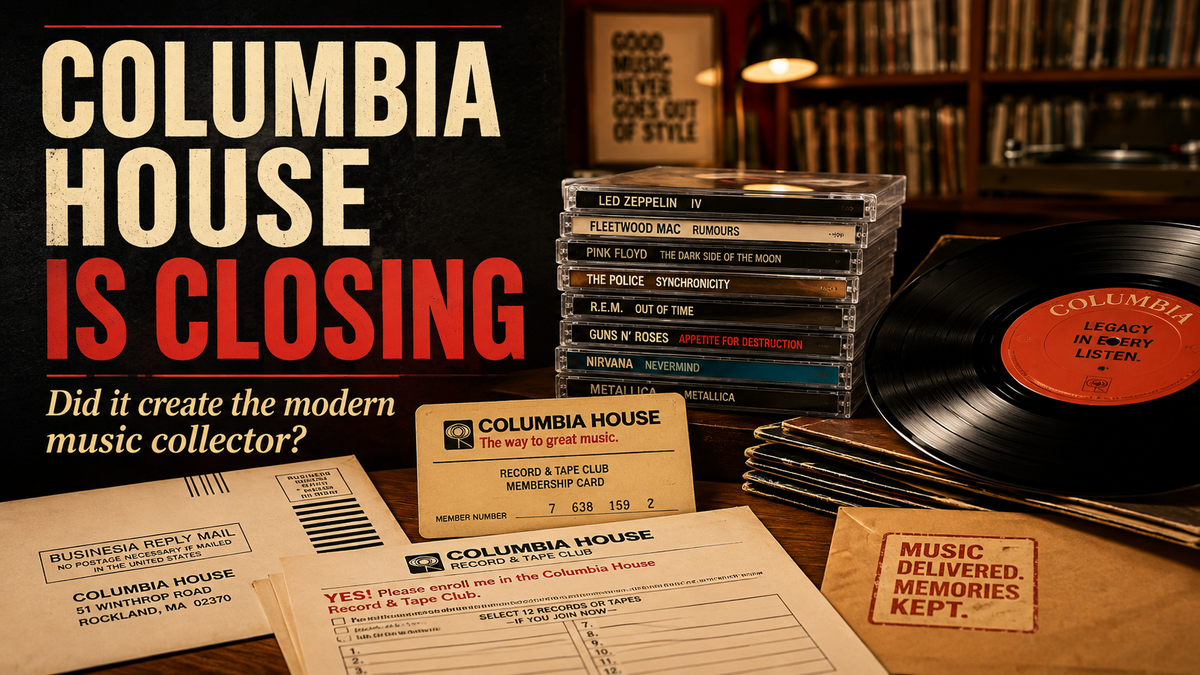
For a certain generation of music fans, few advertisements were more irresistible.
A stack of CDs. A ridiculously small price. The promise that your music collection could suddenly become dramatically larger simply by checking a few boxes and mailing in a card.
Columbia House made the proposition almost impossible to ignore.
Now, after 71 years, the name is finally disappearing.
Columbia House has announced that it will stop accepting new orders after September 15, 2026. What began as the Columbia Record Club in 1955 eventually grew into an enormous mail order music business, reaching a reported 16 million members at its 1996 peak.
There will undoubtedly be plenty of nostalgia surrounding its closure.
But I think the more interesting question is not whether we should miss Columbia House.
It is whether Columbia House helped create the type of music collector that the modern record industry is desperately trying to attract again.
Before Unlimited Music, There Was a Catalog
It is difficult to explain Columbia House to someone who grew up with Spotify, Apple Music, or YouTube.
Today, discovering an album requires almost no commitment.
Hear about a record. Search for it. Press play.
If the opening song does not immediately grab you, there are millions of alternatives waiting.
Columbia House existed in a completely different world.
Music was expensive. Access was limited. Depending on where you lived, your local record store might not carry the album you wanted at all.
Then a Columbia House catalog arrived.
Suddenly, dozens of albums were sitting in front of you.
You studied the covers.
You made choices.
And eventually, a box arrived containing music that was actually yours.
That distinction matters.
A Columbia House membership did not simply give you access to music. It helped build a collection.
The Deal Was Never Quite as Good as It Looked
We should be careful about romanticizing Columbia House too much.
Those famous offers came with strings attached.
Customers typically received a group of albums for an almost absurd introductory price in exchange for agreeing to purchase additional titles later at regular club prices. The company also became notorious for negative option billing, where selections could automatically be shipped and charged unless customers specifically declined them.
Anyone who grew up during the height of Columbia House probably remembers some version of the experience.
The introductory deal looked incredible.
The albums that came afterward could become considerably less incredible.
Shipping charges, purchase commitments, automatically delivered selections, and confusing membership requirements were part of the equation.
This was not a consumer utopia.
Yet buried underneath an aggressive business model was something surprisingly important.
Columbia House made collecting music feel attainable.
It Turned Music Discovery Into Ownership
This might be Columbia House's most interesting legacy.
It connected discovery with ownership.
You did not simply hear a new artist.
You selected the album.
You waited for it.
You opened it.
You looked through the booklet.
You placed it beside the other albums you owned.
And because you had spent one of your precious selections on it, there was a good chance you were going to listen to it more than once.
That last part feels increasingly important.
Streaming has given us access to more music than any previous generation could have imagined.
That is unquestionably a good thing.
But unlimited access has also changed our relationship with individual albums.
There is very little consequence to abandoning a record after 30 seconds.
There is another one waiting immediately behind it.
Ownership creates a different relationship.
When I buy a record today, particularly an expensive pressing, I am making a decision. I chose that album over something else. I physically brought it into my collection.
I am invested before the stylus ever hits the groove.
Columbia House understood that psychology decades before anyone talked about the vinyl revival.
We Got Rid of Scarcity. Then We Started Buying It Again.
This is where the Columbia House story becomes particularly interesting in 2026.
The music industry spent years eliminating friction.
We no longer need to visit a store.
We do not need to wait for an album to arrive.
We barely even need to purchase music.
For the price of a monthly streaming subscription, virtually the entire history of recorded music is sitting in our pockets.
And yet collectors are deliberately bringing friction back.
We preorder records months before release.
We chase limited editions.
We compare mastering engineers.
We debate pressing plants.
We search Discogs for particular variants.
We wait for packages.
We photograph our collections.
We argue about whether the original pressing sounds better.
We have access to almost everything instantly, yet many of us still want the physical object.
That should tell the music industry something.
Access and ownership satisfy two completely different desires.
Streaming solved the access problem.
It never replaced collecting.
Columbia House Even Saw Vinyl Coming
Perhaps the strangest part of the Columbia House story is that someone actually recognized this opportunity years ago.
After the company filed for bankruptcy in 2015, its new owner announced plans to resurrect Columbia House as a vinyl subscription service. The idea was to use the familiar brand to capitalize on renewed interest in records.
Think about how logical that sounds today.
A curated selection of records delivered to your home.
Discovery combined with physical ownership.
A membership built around collecting.
Remove the questionable billing practices, and Columbia House's basic concept suddenly sounds remarkably similar to numerous modern record clubs and direct to consumer vinyl programs.
The original business belonged to another era.
The psychology behind it never disappeared.
Maybe Too Much Choice Is Not Always Better
There is another uncomfortable question worth asking.
Has unlimited choice actually made music discovery better?
We certainly have access to more music.
That does not necessarily mean we develop deeper relationships with more music.
There was something powerful about having fewer options.
When you bought an album and did not immediately understand it, you might play it again.
And again.
Sometimes the song you initially skipped became your favorite song on the record.
Sometimes an album took weeks before it finally clicked.
That experience still happens today, of course.
But streaming makes escape incredibly easy.
A song needs to compete not only with the rest of its album, but with essentially every other song ever recorded.
Maybe physical collecting works partly because it narrows the field again.
Put six records beside the turntable on a Saturday night, and suddenly those six records become your universe.
That limitation can be incredibly satisfying.
The Real Legacy of Columbia House
I do not think we need Columbia House back.
I definitely do not need mysterious full price albums showing up at my front door because I forgot to return a card.
But I think there is something worth remembering about what Columbia House represented.
It made building a music collection exciting.
For millions of people, opening that package was not simply receiving merchandise.
It was watching your musical identity physically grow.
One album became five.
Five became twenty.
Eventually you had shelves filled with music that said something about who you were.
That instinct is still alive.
You can see it every time someone buys their first turntable.
You see it when a teenager buys an album they could stream for free.
You see it when collectors spend an afternoon flipping through bins even though they could find the same music online in seconds.
And you certainly see it when one of us buys another copy of an album we already own because this one has a different mastering engineer, pressing plant, jacket, or piece of colored vinyl.
Columbia House may finally be disappearing.
The collector it helped create is doing just fine.
And maybe that is the most interesting part of this story.
We spent decades building technology that gave us unlimited access to music.
Then many of us discovered that having everything was not quite the same as owning something.
So here is the question:
If Columbia House returned tomorrow offering 12 records for a penny, how many of us would sign up before reading the fine print?


Comments ()