
Boston’s Lost Demos Are Finally Coming to Vinyl. Here’s Why That Matters
Boston’s 50th anniversary edition finally opens Tom Scholz’s archive, pairing the classic debut with original demos that reveal how the band’s signature sound evolved.
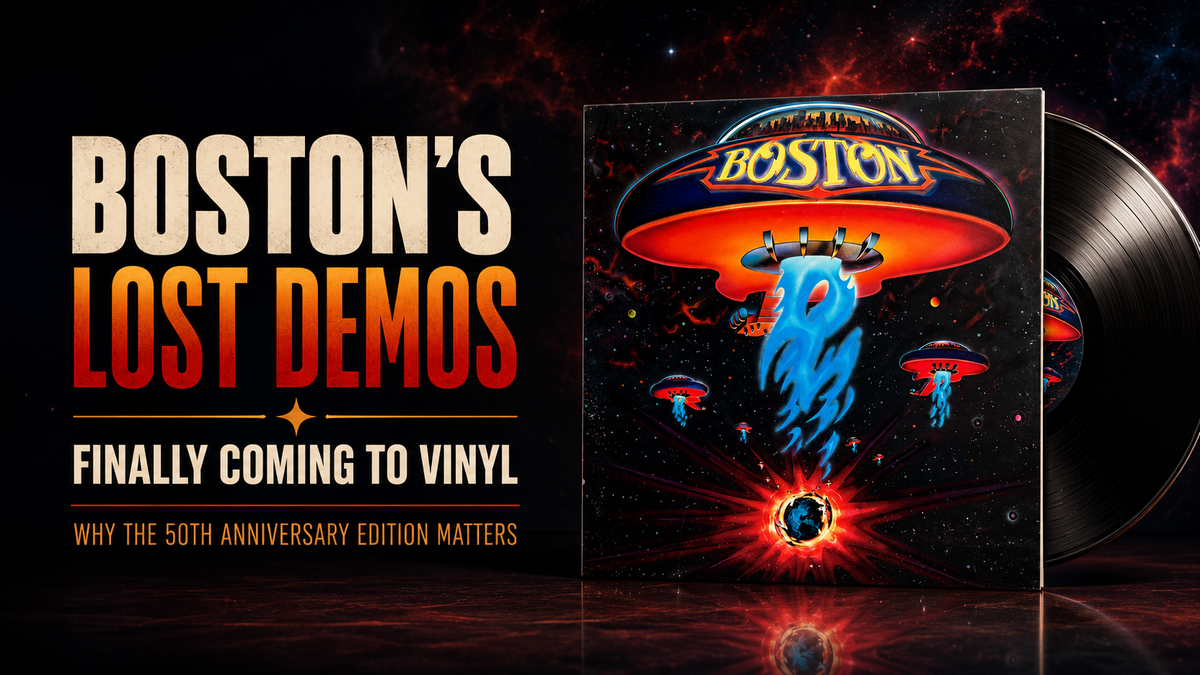
Boston’s self titled debut turned 50 this week, and the anniversary release coming from Tom Scholz and Impex Records looks far more interesting than the usual deluxe reissue.
Yes, the album is being remastered.
Yes, there will be premium vinyl.
Yes, there is a limited gold edition.
But none of that is the real story.
For the first time, Scholz is opening his archive and releasing some of the original demos he shopped to record labels before Boston was signed to Epic Records. Those recordings will appear on a bonus 12 inch EP alongside a newly mastered edition of the 1976 album.
That is what makes this release worth paying attention to.
We are not simply getting another version of Boston.
We are getting a chance to hear what one of rock’s most recognizable albums sounded like before the record industry believed in it.
Before Boston Became Boston
It is difficult to hear “More Than a Feeling” today without all the history attached to it.
The song is everywhere.
So are “Peace of Mind,” “Foreplay/Long Time,” and “Smokin’.”
Boston’s debut spent 132 weeks on the Billboard 200, reached No. 3, and eventually became one of the most successful debut albums in rock history.
But before any of that happened, Tom Scholz was essentially building the sound of Boston in his own world.
He was working as an engineer at Polaroid while developing songs and recording equipment in his basement studio. Those demos were sent to record companies, and they were rejected repeatedly before Epic eventually signed the band.
That part of the story has always fascinated me because the finished album sounds almost inevitable.
It is so polished.
So confident.
So immediately recognizable.
The guitars are huge without becoming muddy.
Brad Delp’s vocals seem to float above the arrangements.
The production is dense, but remarkably controlled.
It sounds like a band that knew exactly what it was doing.
The demos should let us hear how much of that identity already existed before the record deal.
This Is What an Anniversary Edition Should Do
I have been increasingly skeptical of anniversary releases that simply repackage an album we already own.
A different vinyl color does not tell us anything new about the music.
A larger box does not automatically make a record more meaningful.
The best archival releases give us context.
They show us how the album evolved.
That is why these Boston demos are potentially so valuable.
Impex says the recordings were restored by Scholz with Boston guitarist and producer Gary Pihl, but deliberately left in their original sonic state. The idea is to allow listeners to compare the demos directly with the finished album rather than modernizing them into something they never were.
That is exactly what I want from archival material.
Do not make the demo sound like the finished record.
Let me hear the difference.
How Much of the Boston Sound Was Already There?
That may be the most interesting question.
Was the famous layered guitar sound already fully developed?
Were the vocal arrangements essentially complete?
Did the rhythm sections change dramatically?
Were songs structurally different before Epic became involved?
And perhaps most importantly, did the finished album improve everything?
We often assume that the final master represents the most complete realization of an artist’s vision.
Sometimes it does.
But demos can occasionally reveal something the polished version loses.
More immediacy.
More energy.
A different vocal phrasing.
A rough guitar tone that somehow works better.
A tempo that feels slightly more natural.
Scholz was famously obsessive about the sound of Boston, so these comparisons should be especially revealing.
A Rare Opportunity to Hear the Production Process
This is where the release becomes particularly interesting for anyone who cares about recording and sound.
Boston is not simply a collection of strong songs.
It is an engineering achievement.
The album arrived at a time when massive rock production was becoming increasingly ambitious, but Scholz approached the process with an unusually technical mindset.
His background as an engineer mattered.
So did his willingness to keep experimenting until the guitars, vocals, effects, and dynamics behaved the way he wanted them to.
Hearing the demos next to the final album could provide something close to an audio blueprint of that process.
Not a documentary explaining what changed.
The actual recordings.
That is far more useful.
The Vinyl Edition Looks Thoughtfully Done
The standard anniversary edition will contain the original album on a 180 gram 33 RPM LP, plus the 12 inch EP containing selections from the lost demos.
Chris Bellman is mastering the album and cutting the lacquers at Bernie Grundman Mastering, and Fidelity Record Pressing will manufacture the records. The package also includes a tip on gatefold, archival photography, and a new Tom Scholz interview conducted by music historian Chuck Granata.
The standard vinyl edition is priced at $69.99.
There will also be a pearl gold version limited to 2,500 numbered copies at $89.99, adding a poster and a Tom Scholz guitar pick. A Hybrid SACD is planned as well.
The release is currently expected in the second quarter of 2027.
I am generally less interested in the collectible extras than I am in the content itself, but the pricing here at least appears more grounded than some of the triple digit premium releases we have been seeing.
More importantly, the archival material gives collectors a reason to own another version.
That Distinction Matters
There are already many copies of Boston in the world.
Original pressings are not particularly difficult to find.
The album has been reissued many times.
If the anniversary edition were simply another remaster on heavier vinyl, I am not sure the story would be especially interesting.
But adding material that has never been officially available changes the equation.
Now you are not only buying another pressing.
You are buying access to a part of the album’s history that has largely remained private for half a century.
That is a much stronger reason to revisit a classic record.
We Talk About “Definitive” Editions Too Easily
The announcement calls this the definitive anniversary edition.
That word gets thrown around a lot in the record business.
Definitive.
Ultimate.
Final.
Reference.
There is always another reissue eventually.
But in this case, there is at least a legitimate argument for the term.
Tom Scholz is personally supervising the project.
The album is being newly mastered.
The original demos are finally being released.
There is new historical documentation.
And listeners will be able to hear the creative path from rejected demo to finished blockbuster.
That is more substantial than simply increasing the vinyl weight and changing the jacket.
The Rejections Make the Story Better
Perhaps the most compelling part of all this is remembering that these demos did not initially convince record labels.
That is remarkable in retrospect.
Today, Boston’s debut feels engineered for massive success.
Its melodies are immediate.
Its production is enormous.
Its hooks are obvious.
Yet the recordings that eventually became one of the biggest debut albums ever were once tapes that executives passed on.
That should probably remind us how unreliable predictions about music can be.
A song can sound obvious after millions of people have heard it.
Before that, it is just another recording somebody has to believe in.
This Is the Kind of Reissue I Want More Of
I have no problem with reissuing great albums.
The question is whether the new edition adds anything meaningful.
Boston’s 50th anniversary release appears to.
It gives us historical context.
It gives us an opportunity to compare production choices.
It opens an archive that has been closed for decades.
And it may allow us to hear exactly how one of the most carefully constructed rock albums of the 1970s became the record we know today.
I am particularly curious about the demos.
Not because I expect them to sound better.
Maybe they will.
Maybe they will not.
I want to hear what was already there before Boston became a phenomenon, and what Scholz decided still needed to change.
That is the kind of anniversary release that can actually teach us something about an album.
Fifty years later, Boston does not really need another introduction.
But its unfinished history might.


Comments ()