
Big Thief Played 29 Unreleased Songs in One Night. That’s Kind of Brilliant.
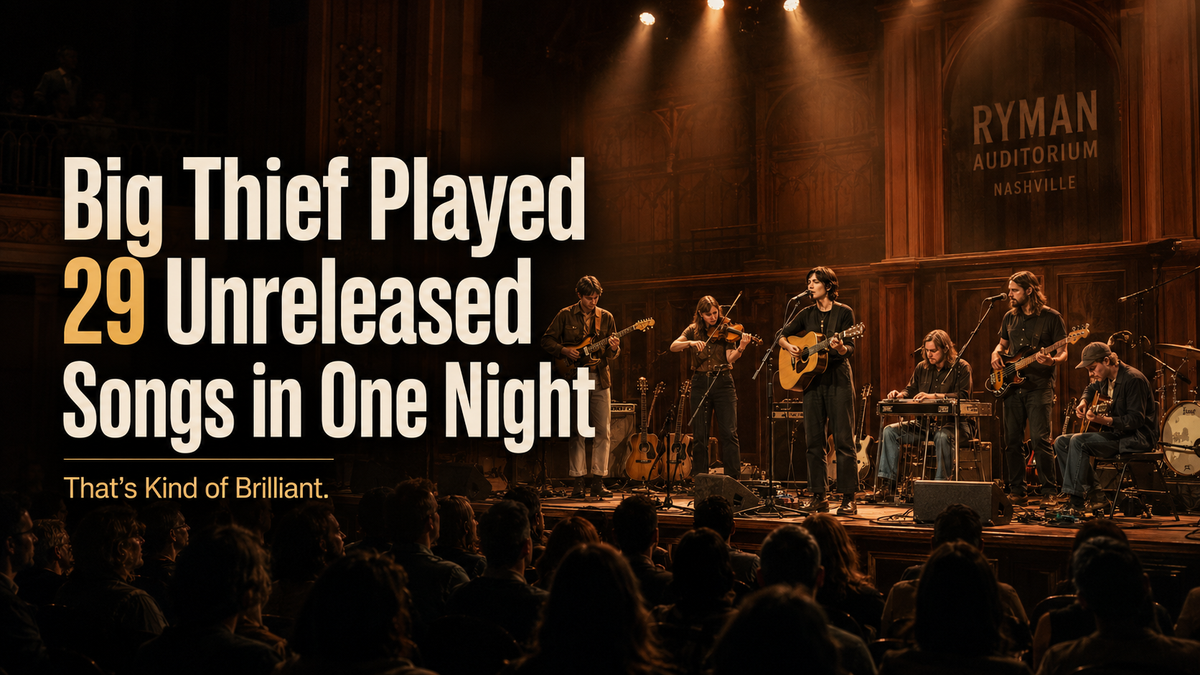
Big Thief debuted all 29 songs from their unreleased triple album 'Horsepower' in a single night at Nashville’s Ryman Auditorium. In an era of teasers, clips, and instant reactions, the band turned listening itself into the event.
There was a time when hearing a new album before everyone else actually meant something.
You might catch a song on the radio. Maybe a record store played an advance copy. Perhaps a band slipped something new into a live set.
Today, new music rarely arrives quietly.
There are teaser clips, social posts, reaction videos, leaks, track rankings, previews, and endless commentary before many of us have even had a chance to hear the album ourselves.
Big Thief just went in almost the opposite direction.
On Saturday night at Nashville’s Ryman Auditorium, the band performed its forthcoming triple album, Horsepower, in full.
Twenty nine songs.
Almost none of them familiar to the audience.
And photography and video were prohibited.
According to Pitchfork, Big Thief did not perform the record in its official sequence, but the audience heard all 29 songs. Guests included Lucinda Williams, Gillian Welch, Iris DeMent, and several musicians who participated in making the album.
That is not a normal album launch.
And I think it is kind of brilliant.
Imagine Hearing an Album Before You Have an Opinion About It
One of the strange things about modern music discovery is how difficult it has become to encounter something completely fresh.
Before an album arrives, we often already know too much.
We know which single is supposedly the best.
We know what critics think.
We know which track is getting the most streams.
We know which song is trending on social media.
We may even know which moments are going to become memes.
By the time we finally sit down and listen to the album, we are rarely approaching it without expectations.
The audience at the Ryman had almost none of that.
They simply had to listen.
There was no track skipping.
No waveform.
No recommendation engine.
No comment section telling them which song mattered.
No immediate ability to replay something they liked.
For one evening, the music existed primarily as a performance happening in front of them.
That feels increasingly unusual.
Twenty Nine New Songs Is a Lot to Ask
There is another reason I find the idea interesting.
Performing 29 unreleased songs in one night is an enormous gamble.
Even fans who love a band generally want familiarity at a concert.
They want the song that made them a fan.
They want the chorus everyone knows.
They want that moment when the first few notes hit and the entire room reacts.
Big Thief apparently decided not to give them much of that.
Adrianne Lenker even joked before the performance that anyone hoping to hear familiar songs could discard those expectations.
Instead, the audience effectively attended a live listening session for a record that has not been released yet.
That requires a certain amount of trust.
The band has to trust that the audience will stay engaged without recognizable material.
The audience has to trust that the band has something worth hearing.
That relationship between artist and listener feels increasingly rare.
The No Phone Rule Matters
The decision to prohibit photography and video may be the most interesting part of the entire event.
I do not think phones are inherently ruining concerts.
People want memories. They want a photo. They want to capture the song they love.
I understand that.
But when the entire purpose of the evening is introducing unreleased music, removing the temptation to document everything changes the experience.
Nobody in that room could immediately upload the new songs.
Nobody could turn a chorus into a TikTok clip before the album was even announced properly.
Nobody could spend the night watching the performance through a six inch screen.
The audience had something that increasingly feels scarce:
an experience that belonged primarily to the people who were actually there.
That exclusivity is part of what made concerts special long before every moment became instantly shareable.
This Is Not About Rejecting Streaming
It would be easy to turn this into another argument about streaming destroying music.
I do not think that is the interesting conclusion.
Streaming gives us access to more recorded music than any generation in history.
That is extraordinary.
The issue is not access.
It is that unlimited access can make individual musical experiences feel less consequential.
If something does not immediately grab us, another album is one tap away.
If a song becomes interesting halfway through, many listeners may never reach that point.
If an album requires several listens, it competes with millions of alternatives demanding attention.
Big Thief temporarily removed that choice.
For those 29 songs, the audience could not skip ahead to see what came next.
They could not save the interesting one and ignore the rest.
They had to experience the music at the pace the musicians presented it.
That is a completely different relationship with an album.
Vinyl Collectors Should Understand This Better Than Most
This is where I think the story connects naturally with Vinyl Latte.
One of the reasons many of us still enjoy playing records has little to do with whether analog automatically sounds better than digital.
A record creates structure around listening.
You choose something.
You take it from the shelf.
You place it on the turntable.
You lower the stylus.
And for the next twenty minutes or so, there is a subtle pressure to stay with the music.
That ritual does not guarantee deeper listening.
But it encourages it.
Big Thief created something similar without involving a record at all.
They created circumstances where listening required commitment.
That is the part I find exciting.
Not the format.
The intention.
We May Need More Musical Events, Not More Content
The music industry produces an astonishing amount of content around albums.
Trailers.
Visualizers.
Shorts.
Unboxing videos.
Alternate covers.
Exclusive variants.
Behind the scenes clips.
Countdowns.
The irony is that all of that activity can sometimes make the actual music feel like just one piece of the campaign.
Big Thief did something much simpler.
They put the musicians onstage.
They played the record.
And people listened.
That should not feel revolutionary.
But in 2026, it almost does.
Perhaps artists should experiment with this idea more often.
Imagine an album premiere where nobody hears the singles beforehand.
Or a theater tour where a new record is performed front to back before release.
Or listening events where the artist talks about the recording after the audience hears it, rather than explaining everything beforehand.
Give people a reason to encounter music as something more than another item appearing in a feed on Friday morning.
There Is Also Something Refreshingly Temporary About It
We have become accustomed to almost everything being available forever.
Miss a concert?
Someone probably uploaded clips.
Miss an interview?
There is an archive.
Miss a livestream?
There may be a replay.
That accessibility is useful.
But impermanence has value too.
The people who heard Horsepower at the Ryman heard something the rest of us did not.
Their memories of those songs are currently disconnected from studio recordings, reviews, mastering discussions, and everything else that will eventually surround the album.
They heard the songs as songs.
Some details will probably be remembered incorrectly.
Some favorites may change completely when the record arrives.
Perhaps songs that seemed insignificant live will become favorites later.
That uncertainty is part of the experience.
This Makes Me More Curious About the Album
And ultimately, that may be the smartest part of the entire exercise.
I have not heard Horsepower.
Most of us have not.
But now I am curious.
Not because I watched a thirty second teaser.
Not because I know which pressing to preorder.
Not because I saw a review score.
I am curious because a band had enough confidence in 29 new songs to walk onto one of America's most famous stages and play all of them for an audience that largely had no idea what was coming next.
That says something.
Whether Horsepower ultimately justifies that confidence remains to be heard.
But as a way of introducing new music, I would happily see more artists take this kind of risk.
Maybe Anticipation Still Matters
We spend so much time discussing how quickly music moves today that we sometimes forget anticipation can be part of enjoying it.
Not knowing everything immediately can be exciting.
Hearing about a remarkable concert without instantly being able to watch the entire thing can create curiosity.
Waiting to hear the finished album can make its eventual arrival feel important.
Big Thief did not solve some great crisis in music consumption.
They simply reminded us that an album premiere can still feel like an event.
Twenty nine unreleased songs.
A legendary room.
A collection of extraordinary guest musicians.
No phones documenting every second.
And an audience asked to do one thing:
Listen.
Maybe that should not feel unusual.
But right now, it does.


Comments ()