
AI Music Can’t Chart in Australia Anymore. But What Actually Counts as Human Music?
Australia has drawn a line on AI generated music, requiring chart eligible recordings to remain substantially human made. But as AI becomes another tool in the studio, defining what counts as a human performance is getting much harder.
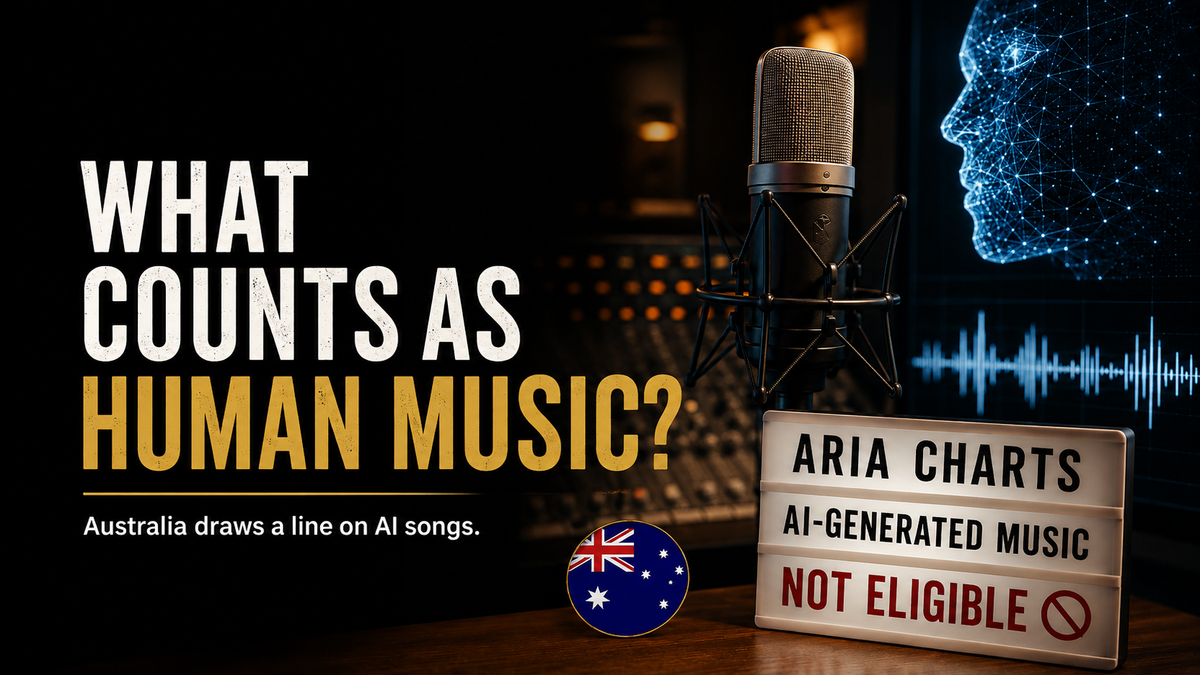
Australia just made one of the clearest moves yet in the debate over AI generated music.
Beginning this week, songs that are fully or mostly created by artificial intelligence will no longer be eligible for the ARIA charts. Music can still use AI in a supporting role, but the finished recording must remain substantially human made.
That sounds straightforward until you start asking what “substantially human made” actually means.
If a person writes the song but the lead vocal is generated by AI, is that still their performance?
If the drums are AI generated but the guitar, bass, and vocals are human, where does that fall?
If AI is used to clean up pitch, separate stems, generate harmonies, or reshape a recording, is that simply another production tool?
The interesting part of ARIA’s decision is not that it bans AI music.
It is that the music industry is now being forced to define where the line sits between technology assisting a musician and technology replacing one.
The Rule Came After a Real Chart Hit
This is not a hypothetical policy written for some distant future.
The immediate backdrop is a version of Madonna’s Like a Prayer produced by Australian DJ Josh Fawaz.
The recording used AI generated vocals and drums, became the most played song on Australian radio, and reached No. 4 on two ARIA charts in July. Fawaz has described AI as a tool in the process, but under the new rules, recordings built around AI generated lead vocals or key instrumentation may no longer qualify.
That is where this becomes more than another debate about whether AI music is good or bad.
A song had already crossed the line from experiment into mainstream consumption.
People were hearing it on the radio.
People were streaming it.
It was competing against recordings made by artists who sang, played, recorded, and performed their own parts.
ARIA has now decided those two things should not necessarily be treated as equivalent.
AI Has Already Been Part of Music for Years
The complication is that technology has been altering musical performances for a very long time.
Pitch correction can reshape a vocal.
Drum replacement can substitute sampled hits for an acoustic performance.
Quantization can move notes into perfect time.
Sampling can turn someone else’s performance into the foundation of an entirely new recording.
Digital editing can assemble a vocal from dozens of takes until the final performance never actually existed in one continuous moment.
None of this is particularly controversial anymore.
And that is important, because it means the question cannot simply be:
Was technology used?
Of course it was.
Almost every modern recording uses technology extensively.
The better question is:
Who made the creative decisions, and who actually performed the music we are hearing?
That distinction matters.
A Tool Is Different From a Performer
This is also the line Beatport appears to be drawing.
The electronic music platform recently expanded its AI detection program and now rejects music that is fully or majority AI generated. Tracks created with AI assistance are still allowed as long as the finished work remains majority human made. Those releases are tagged internally so Beatport’s curation team knows how AI was used.
Beatport CEO Matt Gralen framed the distinction clearly: there is a difference between technology that assists human creation and a system that replaces it.
That is probably the most useful way to think about this.
A guitarist using an AI tool to remove background noise is still the guitarist.
A singer using software to adjust pitch is still the singer.
A producer using AI to separate a stereo mix into stems is still making production decisions.
But if the singer never existed, the drummer never played, and a model generated the performance itself, the relationship between artist and recording has changed considerably.
Why This Matters to People Who Care About Sound
Audiophiles spend an enormous amount of time discussing provenance.
Was the record cut from the original master tape?
Was there a digital step?
Who mastered it?
Where was it pressed?
Was the original mix altered?
We ask these questions because the process behind a recording matters to us.
AI introduces another provenance question.
Who, or what, are we actually hearing?
That does not mean an AI generated recording cannot sound impressive.
Sound quality and human performance are separate questions.
A completely synthetic recording could theoretically have extraordinary dynamics, imaging, frequency response, and production quality.
But audiophiles also tend to care about something measurements cannot fully capture: the connection between the sound coming from the speakers and the people who created it.
When I hear a drummer push slightly ahead of the beat, I am hearing a decision.
When a singer strains for a note, I am hearing a physical performance.
When musicians respond to each other in real time, those interactions become part of the recording.
AI can reproduce the characteristics of those things.
Whether it is reproducing the same thing is another question.
The Hard Cases Are Going to Get Harder
ARIA’s rule will probably work well at the extremes.
A recording generated entirely from a prompt is clearly on one side.
A traditional band recording that uses AI noise reduction is clearly on the other.
Everything in between is going to be messy.
Imagine an artist writes the lyrics and melody, then uses AI to generate the instrumental arrangement.
What if a producer performs a keyboard part and an AI system transforms it into an orchestral arrangement?
What if a singer records a vocal, but AI changes the voice into something completely different?
What if a deceased artist’s voice is generated from archival recordings with approval from the estate?
The phrase “substantially human made” sounds sensible, but music production does not divide neatly into percentages.
Eventually, someone has to decide what counts.
That is where policies like this will be tested.
Transparency May Matter More Than Prohibition
I am not convinced that banning every form of AI from music would be useful or even possible.
Technology has always changed the way recordings are made.
Multitrack recording changed performance.
Synthesizers changed instrumentation.
Sampling changed authorship.
Digital editing changed what constitutes a take.
AI will change production too.
The better standard may be transparency.
If AI generated the lead vocal, tell us.
If a model generated the backing track, disclose it.
If AI was used only for restoration or editing, that is useful context too.
Collectors already ask for mastering credits and source information.
Perhaps AI provenance simply becomes another part of the liner notes.
There is a major difference between discovering that a recording used an AI restoration tool and discovering that the singer you thought you were hearing never existed.
Listeners should be able to know which one they bought.
ARIA May Be Setting an Important Precedent
More than 20 official chart programs are reportedly moving toward similar standards based on principles developed by the International Federation of the Phonographic Industry.
That suggests Australia may not remain an isolated case.
And perhaps that is inevitable.
Charts have always been more than measurements of popularity.
They are part of how the music industry recognizes artists, allocates attention, and defines commercial success.
If millions of automatically generated tracks can compete under exactly the same rules as human performers, eventually the charts stop measuring the same thing they were designed to measure.
The difficult part will be protecting human creation without pretending technology can somehow be removed from modern music.
It cannot.
The Line Should Be About Creative Responsibility
For me, the most sensible dividing line is not whether AI touched the recording.
It is whether a person remains responsible for the performance and the creative decisions at the center of it.
Use AI to clean the recording.
Use it to organize sessions.
Use it to experiment with sounds.
Use it as another production tool.
But if the voice, musicianship, and core performance are generated by a machine, we should probably describe that honestly as something different.
Not necessarily worse.
Not necessarily worthless.
Just different.
ARIA’s new rule does not settle the AI music debate.
But it asks the right question.
As technology becomes capable of generating increasingly convincing performances, we are going to need a clearer understanding of what we mean when we call something an artist’s recording.
For the first time, that definition may matter just as much as what the music sounds like.


Comments ()