
Frank Beard, ZZ Top Drummer, Dies at 77: Why Fandango! Is the Record to Play Tonight
Frank Beard, the legendary drummer behind ZZ Top’s unmistakable groove, has died at 77. We look back at his legacy, and why Fandango! is the record to play tonight.
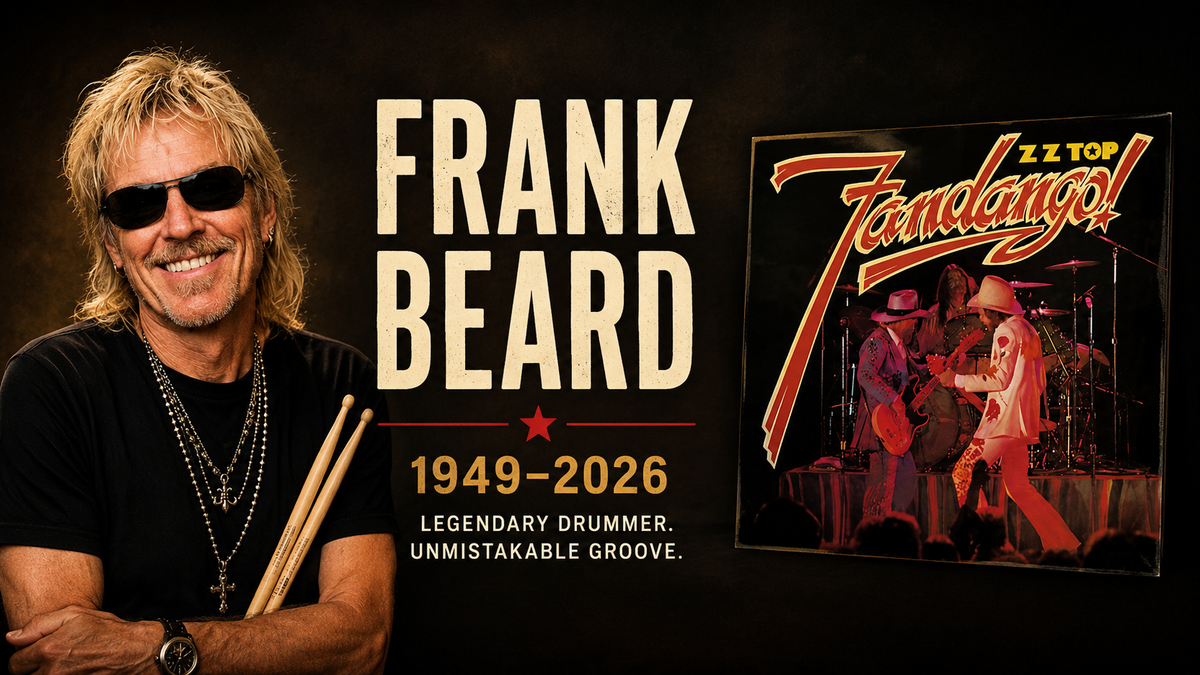
Frank Beard, the drummer whose unmistakable groove helped power ZZ Top for more than five decades, has died at 77.
Billy Gibbons announced Beard’s passing today, remembering his longtime bandmate as a friend, collaborator, and one of Texas’ great drummers. Gibbons specifically pointed to Beard’s signature backbeat as a fundamental part of the ZZ Top sound.
It is difficult to argue with that assessment.
ZZ Top will forever be visually associated with Billy Gibbons, Dusty Hill, long beards, sunglasses, hot rods, and the videos that made the band unlikely MTV superstars. But underneath all of it was something much simpler.
Three musicians locked into a groove.
And Frank Beard was the guy holding it together.
If there is a record worth pulling from the shelf tonight to remember him, my choice would be Fandango!
More Than the Guy Behind the Kit
Beard joined Billy Gibbons and Dusty Hill in Houston in 1969, creating the trio that would define ZZ Top for the next half century. Their first album followed in 1971, but it was Tres Hombres in 1973 that pushed the band into the mainstream and established the stripped down Texas blues and boogie sound that became their foundation.
It is easy to focus on Gibbons.
His guitar tone is enormous. His riffs are instantly recognizable. He is also one of rock music’s most distinctive personalities.
But a riff like that only works if the rhythm section knows exactly what to do with it.
Beard rarely seemed interested in competing with the guitar for attention. Instead, his playing gave ZZ Top its momentum. There is weight behind the beat, but also space. The drums push without constantly announcing themselves.
That restraint is part of what made the band sound so big.
Great rock drumming is not always about how many notes someone can play. Sometimes it is about knowing exactly where the beat needs to land, and understanding what not to play.
Frank Beard understood that exceptionally well.
Why Fandango! Tonight?
There are plenty of obvious ZZ Top records to choose from.
Tres Hombres gave us “La Grange.”
Eliminator transformed the band into international superstars.
Degüello remains one of the strongest albums in the catalog.
But Fandango! gives us something those records cannot.
It gives us ZZ Top live.
Released in April 1975, Fandango! is an unusual record. The first side consists of live recordings, while the second contains new studio material. The live portion came first, with the band deciding they had enough material to devote an entire side of the album to capturing the energy of their performances.
That makes it a particularly fitting way to appreciate Beard.
Put on the first side and listen beyond Gibbons’ guitar.
Listen to the way Beard controls the pace.
“Thunderbird” comes flying out of the speakers with the loose confidence of a band that knows exactly where everyone else is going. “Jailhouse Rock” turns into something heavier and dirtier than the familiar Elvis Presley version.
Then comes the nearly ten minute “Backdoor Medley.”
This is where the argument for Fandango! becomes particularly convincing.
There is no polished music video, synthesizer, studio trick, or elaborate production to hide behind. It is Gibbons, Hill, and Beard playing blues soaked rock in front of an audience.
The chemistry is the attraction.
Rhino once described Beard’s drums on the live side as going off like cannon shots. That description works, but what impresses me more is how controlled those cannon shots actually are.
Beard could hit hard without making the music feel heavy.
There is a difference.
Then Flip the Record Over
Side two shows the other side of ZZ Top.
Now we are in the studio, but the groove remains.
“Nasty Dogs and Funky Kings” has swagger. “Blue Jean Blues” slows everything down. “Heard It on the X” captures the band’s Texas roots and the influence of the powerful border radio stations they heard growing up.
And then there is “Tush.”
It would become ZZ Top’s first Top 40 single, reaching No. 20 on the Billboard Hot 100.
Listen specifically to the drums.
There is nothing needlessly complicated about what Beard is doing.
That is precisely why it works.
The beat is relentless, the pocket is enormous, and every element of the band has room to breathe. You could remove almost anything from that arrangement and change the character of the song, but adding more would probably make it worse.
That kind of musical judgment is easy to overlook.
Until the person making those decisions is gone.
The Sound of Three Musicians
The death of Dusty Hill in 2021 already changed something that had seemed nearly permanent.
For more than 50 years, ZZ Top represented something increasingly rare in rock music: essentially the same three musicians, together decade after decade.
Beard’s death makes that history feel even more finite.
There will be plenty written about the videos, the cars, the beards, the humor, the Texas mythology, and the enormous commercial success.
All of those things matter.
But records have a wonderful way of stripping history back down to the thing that started it.
The music.
And when you listen to ZZ Top that way, it becomes impossible to separate Frank Beard from what made the band work.
The guitar may grab your attention first.
The groove is what keeps you there.
Put on Fandango!
So tonight, I would skip the greatest hits collection.
Pull out Fandango! instead.
If you have it on vinyl, start with Side One. Turn it up enough that the live recording begins to feel like a performance rather than something happening between your speakers.
Then stop concentrating on Billy Gibbons for a few minutes.
Listen behind him.
Listen to the kick drum. Listen to the snare. Listen to the spaces between them. Listen to how Beard and Hill move together, and how much freedom that gives Gibbons.
Then flip the record over and play “Tush.”
Frank Beard spent more than half a century providing the heartbeat behind one of the most recognizable bands in American rock.
Today, that heartbeat stopped.
Fortunately, we still have the records.
And tonight, Fandango! feels like the right one to play.


Comments ()