
Before the Major Labels: Melissa Auf der Maur Opens Her ’90s 4 Track Archive
Melissa Auf der Maur opens her ’90s archive, sharing raw 4 track demos and field recordings that capture what she was creating away from the major label machine.
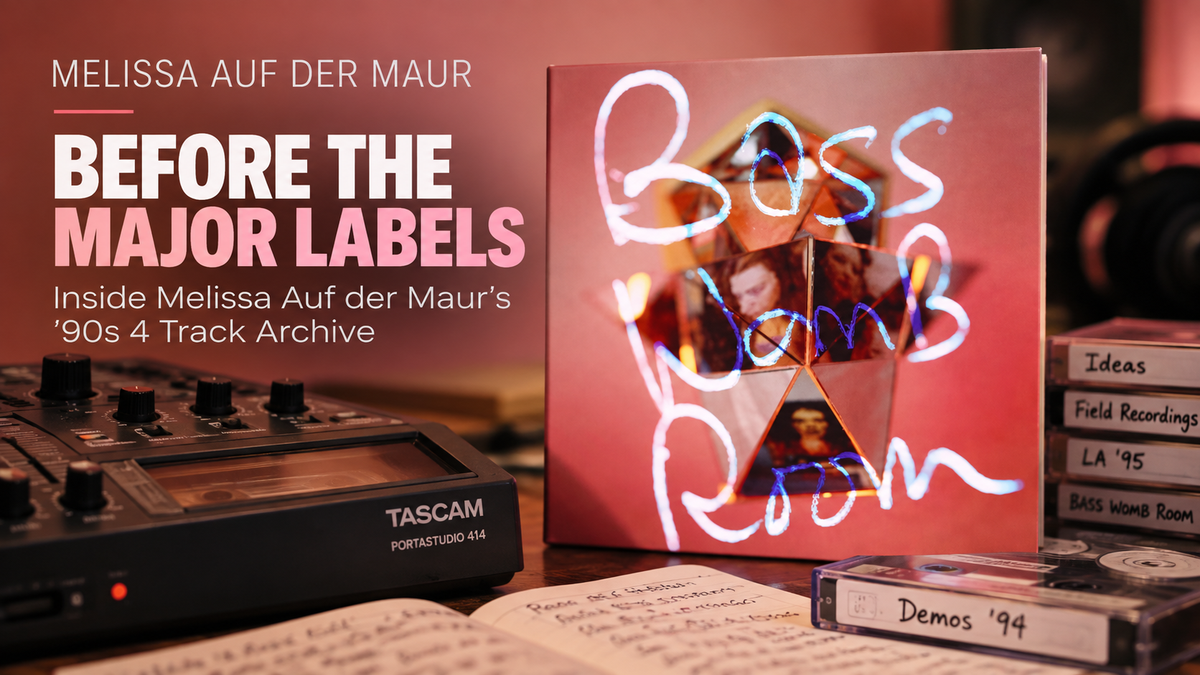
There is something fascinating about hearing music that was never supposed to become an album.
Before Pro Tools sessions could contain hundreds of tracks, before musicians could make endless revisions on a laptop, and before every unfinished idea had the potential to become content, there was the cassette 4 track.
Four tracks.
A few microphones.
Maybe some pedals.
And whatever you could figure out in your bedroom.
Melissa Auf der Maur has just opened a remarkable window into that world.
BASS WOMB ROOM: My ’90s 4-Track Demos x Field Recordings, released September 4 through Envision Records, combines seven previously unreleased demos Auf der Maur recorded herself during the 1990s with eight newer interludes created for her photography exhibition at the Art Gallery of Ontario. It is her first new music in roughly 15 years.
But calling this a collection of old demos undersells what makes it interesting.
These recordings capture a version of Melissa Auf der Maur that existed alongside, but largely outside, the major label alternative rock machine of the 1990s.
And the limitations of the equipment may be precisely why they survived with that character intact.
While Hole Was Making Records, Auf der Maur Was Making Tapes
Auf der Maur is best known for playing bass with Hole during the band's enormously successful late ’90s period and later touring with the Smashing Pumpkins.
That put her inside one of the most commercially important moments in alternative rock.
But when she went home, she was making something very different.
The seven archival songs on BASS WOMB ROOM were created in her Los Angeles living room using a Tascam 4 track cassette recorder. Auf der Maur wrote, performed, and initially mixed the recordings herself. Acoustic guitar frequently provided the foundation, with vocals, bass, a cheap keyboard, and a vintage Ross phaser added around it.
Then she started manipulating the tape itself.
Cassettes were flipped backward. Sounds were pitch shifted. Everyday noises captured on a small cassette dictaphone became source material, including a dripping faucet and the shutter of her camera.
Even the lyrics sometimes came directly from the diary she was keeping at the time.
This wasn't someone trying to recreate lo-fi aesthetics 30 years later.
It was simply how the music was made.
The Limitations Are Part of the Recording
We've become extraordinarily good at removing limitations from recording.
A modern home studio can provide essentially unlimited tracks, nondestructive editing, sophisticated virtual instruments, pitch correction, automation, and processing that would have required an extraordinarily expensive studio when these demos were made.
That's unquestionably progress.
But limitations can also influence creativity.
A 4 track forces decisions.
If you've already used your available tracks and want to add something else, you need to combine elements, bounce tracks, or give something up.
Editing isn't a mouse click.
Manipulating a sound may mean physically manipulating the tape.
And if you make a decision you don't like, going backward isn't necessarily easy.
That makes a cassette 4 track more than simply an inexpensive version of a professional recording studio.
It's an instrument in the creative process.
Listening to BASS WOMB ROOM with that in mind changes what these recordings represent.
The roughness isn't necessarily something that needs to be fixed.
It's evidence.
What Did Artists Sound Like Before Anyone Asked for a Single?
There's another layer to these recordings that makes them especially interesting.
Envision describes the demos as being created while Auf der Maur and her peers were facing increasing pressure from the major label music industry to make polished songs capable of dominating radio. Her private recordings became a kind of internal rebellion, maintaining a connection to the Montreal art scene she came from while her professional life moved deeper into the American rock industry.
That's what makes archival demos like these valuable.
They let us hear an artist before some of the normal questions surrounding a commercial record enter the room.
Where's the single?
Can the chorus arrive sooner?
Is the arrangement too strange?
Will radio play it?
Does this sound like the band's last record?
Those questions aren't inherently bad. Great producers and record executives have helped turn unfinished ideas into extraordinary records.
But they change things.
A private demo doesn't necessarily have to accomplish anything.
And sometimes that makes it a more revealing document of the person who created it.
This Isn't Really a ’90s Nostalgia Project
It would be easy to package all of this as another celebration of the 1990s.
The project certainly has plenty of material for that.
Auf der Maur spent those years carrying a camera while touring with Hole and the Smashing Pumpkins. Her photographic archive eventually grew to more than 10,000 images. More than 200 are now being presented by the Art Gallery of Ontario in Melissa Auf der Maur: My ’90s Rock Photographs, which opens to the general public today, September 8.
The accompanying 240 page book also arrives this week.
But what's interesting is how all these pieces interact.
The photographs document what Auf der Maur was seeing.
The field recordings document what she was hearing.
And the 4 track tapes document what she was creating privately.
Together they form something closer to an archive than an anniversary celebration.
The AGO calls the photography exhibition a look at the “last analogue decade,” and in this case that description feels particularly appropriate.
These weren't photographs filtered later to resemble film.
They weren't digital recordings processed to sound like cassette tape.
They are artifacts created using the technology that actually surrounded her at the time.
Some of the Strangest Recordings Came From the Road
The eight interludes connecting the archival demos bring another part of that history into the album.
While touring, Auf der Maur sometimes positioned a Handycam on top of her bass amplifier, pointing it toward the audience. Audio captured during those years became source material for the newer compositions created for the museum installation.
That creates an unusual relationship between past and present.
This isn't simply a tape pulled from a box and transferred to a computer.
Auf der Maur and producer Alex Crow have taken fragments of her recorded history and placed them around the original demos, effectively allowing her present day perspective to interact with the person who recorded those songs three decades earlier.
The finished album was mixed by Radwan Ghazi Moumneh and mastered by Ryan Morey.
That distinction matters.
The original demos remain products of their time, while the album surrounding them is a contemporary presentation of that archive.
And Yes, It's Coming to Vinyl
There is an interesting physical media component here too.
BASS WOMB ROOM initially arrived digitally and as a limited edition pink cassette, which might actually be the most conceptually appropriate format possible for a project built around cassette recordings.
But vinyl is coming.
A standard black LP and a limited translucent colored galaxy pressing are scheduled for December 4. The colored edition is limited to just 300 copies.
That creates an interesting transformation.
Music originally captured privately onto cassette tape in a Los Angeles living room will eventually be cut onto vinyl and sold as an intentionally preserved artifact.
Thirty years ago, these were working tapes.
Now they're an archive.
We Spend a Lot of Time Trying to Make Old Recordings Sound Better
Audiophiles naturally gravitate toward restoration.
We want better tape transfers.
Better mastering.
Quieter pressings.
Greater resolution.
Lower noise.
More information.
Usually, those are worthwhile goals.
But BASS WOMB ROOM is a useful reminder that there are recordings where removing every imperfection could also remove part of what makes them historically interesting.
Tape hiss tells you something.
A crude edit tells you something.
An overloaded input tells you something.
A track that feels unfinished tells you something.
The goal of an archival release shouldn't always be to make an old recording sound as though it were made yesterday.
Sometimes the better goal is to let yesterday sound like yesterday.
Maybe That's Why These Tapes Matter Now
Melissa Auf der Maur could have made a polished new studio album.
Instead, her first musical release in roughly 15 years asks us to listen to ideas recorded by a much younger artist sitting in a room with four tracks of cassette tape.
There's something wonderfully appropriate about that.
We spend a lot of time talking about the sound of the 1990s as though it can be reduced to certain guitars, production techniques, bands, or records.
But sometimes the more interesting history exists outside the albums everyone remembers.
It's on rehearsal tapes.
It's in unfinished demos.
It's on forgotten cassettes.
It's in photographs that sat in boxes for decades.
And occasionally, somebody opens the archive and lets us hear it.
BASS WOMB ROOM doesn't just document what Melissa Auf der Maur was doing while she was part of one of the biggest periods in alternative rock.
It documents what she was doing when nobody was asking her to make a hit.
And that may tell us considerably more.


Comments ()