
AI Music Is Coming to Vinyl. Does That Change What a Record Means?
AI music is coming to vinyl, raising a bigger question: if the music was generated by a machine, does the record still mean the same thing?
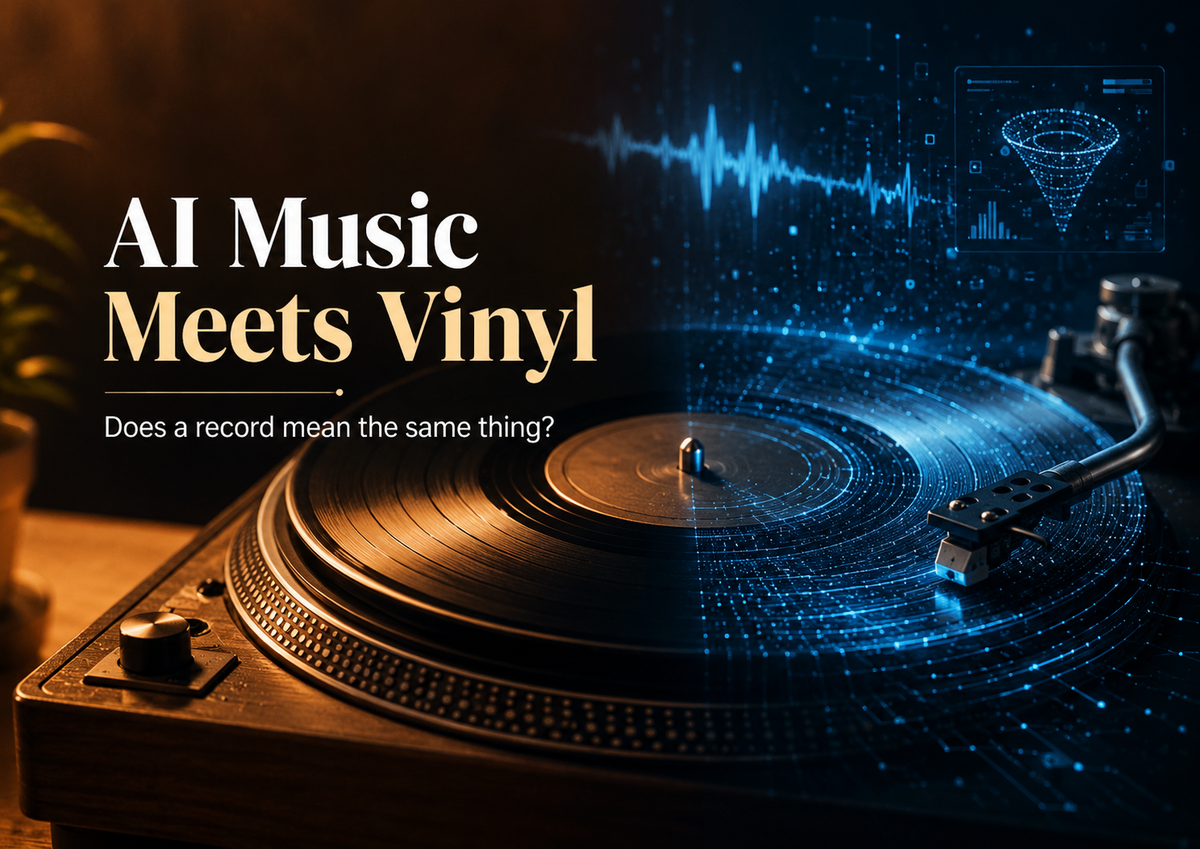
Vinyl has survived the CD, the MP3, streaming, and more than a few predictions of its death.
Now it gets AI.
Suno, one of the biggest names in generative music, is preparing to launch Suno Vinyl, a service that will allow users to take music from their Suno library and turn it into a physical 12 inch record. Users will be able to assemble up to 46 minutes of music, create their own artwork, and receive a professionally pressed record for an estimated $45 plus shipping. The service is not yet live, but Suno has opened a waitlist.
On the surface, this is simply another custom record service.
But I think it raises a much bigger question.
If nobody actually performed the music, does putting it on a record change what that record means?
And more importantly, should the person buying or listening to it always know?
Vinyl Has Never Just Been About the Plastic
There is something almost perfect about AI music arriving on vinyl.
These two things represent almost opposite ends of how we experience music.
Generative AI promises speed. Type something into a box, describe what you want, and a song can appear moments later.
Vinyl demands inconvenience.
You have to choose the record. Remove it from the sleeve. Clean it. Place it on a turntable. Lower the stylus. Twenty minutes later, you probably have to get up and flip it over.
Yet millions of us continue to choose the inconvenient option.
Why?
I don't think it is simply because vinyl sounds better. Sometimes it does. Sometimes it absolutely does not.
The appeal is bigger than sound quality.
A record is a physical connection to music and, traditionally, to the people who made it. There are musicians, songwriters, engineers, producers, mastering engineers, photographers, designers, and countless other people behind the object sitting on your shelf.
The record becomes evidence that something happened.
Someone wrote this.
Someone played this.
Someone sang this.
Someone recorded this.
That does not mean AI cannot be part of the creative process. Technology has been part of music creation for generations. Synthesizers, drum machines, sampling, pitch correction, digital editing, and software instruments have all triggered their own debates over what counts as "real" music.
But generative AI introduces something different.
It can potentially remove much of the human creative process altogether while leaving us with a product that looks remarkably similar to the one created by people.
And now that product can even be placed on your turntable.
The Timing Could Not Be More Interesting
Suno's move into physical records would be interesting enough on its own.
What makes the story worth paying attention to is everything happening around it.
This week, Spotify announced that it will begin identifying certain profiles with an AI Persona badge when the public identity presented as the artist may be generated by AI rather than representing a real person.
Spotify is also going further. By default, music from AI Personas will not appear in Spotify's editorial or algorithmic recommendations unless listeners have taken actions such as following those artists. Spotify says its programming will instead focus on authentic artists building careers in music. Importantly, Spotify says the badge addresses the identity of the artist, not necessarily how the music itself was created.
That distinction matters.
Spotify is essentially acknowledging that listeners increasingly need context about who, or what, they are listening to.
And that brings us back to vinyl.
If that context matters when we press play on Spotify, shouldn't it matter when we spend $40 or $50 on a physical record?
Then There Is the D'Addario Controversy
An even better example of why transparency matters arrived from a place few people probably expected.
D'Addario, a company whose products are literally used by musicians to make music, recently faced criticism over a promotional video for its guitar strings. Viewers questioned whether generative AI had been involved in the music featured in the demonstration.
The company initially denied it.
After further scrutiny, D'Addario acknowledged that Suno Studio had been used to regenerate the original track. The company apologized for providing inaccurate information, as well as for how some critical comments had been handled, and said it would strengthen its rules surrounding the disclosure and use of generative AI.
For me, that is where the real AI discussion becomes interesting.
The problem wasn't simply that AI had been used.
It was that people wanted to know what they were hearing, and the answer wasn't clear.
Trust became the issue.
And I suspect trust is going to become one of the most important currencies in music.
Meanwhile, the Music Industry Is Not Rejecting AI
It would be easy to frame all of this as musicians on one side and AI companies on the other.
Reality is already much messier.
On August 12, BMG announced a global strategic alliance with Suno covering BMG's recorded music and publishing repertoire. According to BMG, participating artists and songwriters will have choices around involvement, rights protection, and compensation. The companies say they will work together on Suno's upcoming music model being developed in partnership with the music industry.
So while Spotify is introducing additional signals to help listeners identify artificial artist identities, one of the world's major music companies is simultaneously working directly with Suno.
That tells me something important.
AI music is not going away.
The meaningful argument probably isn't whether AI should exist in music.
That argument may already be over.
The question is how we preserve transparency, attribution, compensation, and human creativity while these tools become increasingly powerful.
Does AI Music Belong on Vinyl?
Here is where I may surprise some people.
I don't think we should ban AI music from vinyl.
If someone creates something using Suno, loves it, and wants a physical copy sitting on their shelf, why shouldn't they have one?
It is their money and their record.
Maybe someone generates a ridiculous birthday song for a friend and presses a single copy as a gift. Maybe a musician uses AI as one element of a much larger creative process. Maybe someone who has never played an instrument suddenly becomes interested in arranging, producing, or songwriting because an AI tool gave them an entry point.
There are legitimate creative possibilities here.
My concern starts when the line between those things and traditionally created music becomes invisible.
Imagine walking into a record store several years from now.
Two new albums are sitting beside each other.
One represents months or years of songwriting, rehearsing, performing, recording, mixing, mastering, artwork, and production.
The second began with a prompt and was generated in minutes.
Both have convincing artwork.
Both have artist names.
Both cost $39.99.
Should you have the right to know which is which?
I think you should.
Maybe Disclosure Becomes Part of the Liner Notes
The solution doesn't have to be complicated.
We already credit producers, musicians, engineers, songwriters, photographers, and mastering facilities.
Why shouldn't AI use become another credit?
If generative AI created the vocals, say so.
If it generated the instrumentation, say so.
If an artist wrote and performed everything but used AI to help separate stems or clean up a recording, say that too.
There is a huge difference between using AI as a tool and asking AI to create the work itself.
Treating those situations as identical does not help artists, listeners, or the technology.
Transparency does.
In fact, disclosure might actually help legitimate uses of AI because listeners would no longer have to wonder whether someone is trying to hide something.
What Are We Actually Collecting?
This brings me back to the thing I find most fascinating about Suno Vinyl.
Collectors often say they collect music.
I'm not sure that's completely true.
We collect stories attached to music.
The original pressing.
The record recorded in a particular studio.
The album where a band was falling apart.
The mastering engineer whose initials we search for in the deadwax.
The singer who recorded a vocal in a single take.
The guitarist who somehow captured the perfect solo.
The pressing that almost never happened.
Those stories become part of why an object matters.
Remove all of them and you may still have music.
You may even have very good music.
But do you have the same reason to collect it?
That is the part AI cannot simply generate with better fidelity.
Not yet, anyway.
Vinyl May Be the Perfect Place for This Debate
Ironically, I think AI coming to vinyl could force us to think more deeply about why we came back to physical music in the first place.
Streaming gave us virtually unlimited access.
Vinyl gave us something streaming couldn't.
Scarcity.
Ownership.
Artwork.
Ritual.
Context.
And, perhaps most importantly, connection.
Suno can absolutely put AI generated music onto a physical record.
The more interesting question is whether making something physical automatically makes it meaningful.
I don't think it does.
Meaning comes from the relationship between the music, its creator, and the listener.
And as AI becomes better at creating the appearance of that relationship, transparency about who actually created what may become more important than ever.
So I want to know what you think.
Would you buy a record containing AI generated music?
And if AI was used in creating an album, should that information be clearly disclosed on the record?
Because I suspect this isn't going to be a hypothetical question for very long.


Comments ()