
Stack Audio SERENE Mat and Stabiliser Review: Finding Harmony in the Groove
We review the Stack Audio SERENE Mat and Stabiliser on a Rega Planar 10, evaluating improvements in detail, openness, bass texture, and sound quality.

After reviewing the SERENE Stabiliser on my Rega Planar 10, a tonearm upgrade finally gave me the opportunity to evaluate Stack Audio's innovative record mat and discover what happens when both products work together.
There's something fascinating about vinyl playback. We're asking a tiny stylus to trace microscopic variations in a rotating groove, convert those movements into an electrical signal, and ultimately reproduce a musical performance.
Considering how delicate that process is, it's remarkable how well it works.
It's also why vibration management remains such an important part of turntable design. The goal isn't simply eliminating vibration. After all, the movement of the stylus is precisely what allows us to hear the music. The challenge is controlling unwanted mechanical energy without interfering with the information we're trying to retrieve.
Over the years, I've experimented with various approaches to improving my analog playback system. Some changes have been worthwhile. Others have left me wondering whether I was hearing an improvement or simply something different.
That distinction matters, particularly when evaluating accessories intended to extract more performance from equipment that's already operating at a high level.
Which brings me to the Stack Audio SERENE Mat and Stabiliser.
Some time ago, I reviewed the SERENE Stabiliser on my Rega Planar 10, which was then equipped with its original RB3000 tonearm.
I came away impressed.
The Stabiliser delivered worthwhile improvements in spatial presentation, instrumental clarity, and bass articulation. But there was one part of the SERENE story I couldn't explore.
The SERENE Mat.
My original tonearm arrangement limited my ability to accommodate the Mat's additional thickness while maintaining the cartridge geometry I wanted. As a result, I couldn't properly evaluate the Mat or determine whether combining it with the Stabiliser would produce additional benefits.
That changed when I upgraded to the SUPATRAC Blackbird tonearm.
With greater flexibility in setting up the cartridge's playing geometry, I could finally revisit the SERENE products. This time, I evaluated the Mat independently, the Stabiliser with the original Rega mat, and both products together.
What began as a straightforward accessory review had become an opportunity to answer a question I'd been carrying since my original evaluation.
Could two different approaches to vibration management complement one another, or would their combined effect simply be more of the same?
The answer turned out to be more interesting than I expected.
Under the Surface: The Engineering Behind SERENE
At first glance, neither product looks particularly complicated. One is a black platter mat, the other a compact record stabiliser. But the engineering beneath those understated designs is considerably more interesting.
Stack Audio approaches both products with a shared objective: controlling unwanted mechanical energy without relying exclusively on mass or conventional damping materials.
What distinguishes the SERENE range is how each accessory attempts to accomplish that.
The SERENE Mat: A Suspension System for Your Records
Most platter mats are relatively passive. Felt, cork, rubber, and silicone each have different mechanical properties, but their effectiveness depends on how they interact with the record and platter.
The SERENE Mat takes a different approach.
Made from a specially formulated silicone, the 3 mm thick Mat incorporates four tuned sprung pads, each featuring a raised contact point. Rather than allowing the record to rest uniformly across a conventional flat surface, these supports are designed to flex under the record's weight.
Think of it as a miniature suspension system operating directly beneath the vinyl.
As the record vibrates, the supports are intended to absorb some of that mechanical energy rather than allowing it to move freely between the record and platter.
Stack Audio says it developed the spring arrangement through 29 design iterations using computer modelling, with the goal of managing vibration across a broad frequency range.
The distinction is important. A conventional mat relies largely on the properties of its material, whereas the SERENE design incorporates mechanical compliance into the support structure itself.
The manufacturer publishes comparative modelling against conventional mat materials, although those results should not be confused with independent measurements of audible performance.
There's also a practical consideration: the four sprung supports are designed to work with the record's weight. Excessive downward pressure from a screw-down clamp could interfere with their intended operation.
According to Stack Audio, the Mat is compatible with conventional record weights up to 500 grams, but not screw-down clamps.
The SERENE Stabiliser: Tension, Particles, and Controlled Energy
The Stabiliser is arguably the more unconventional of the two products.
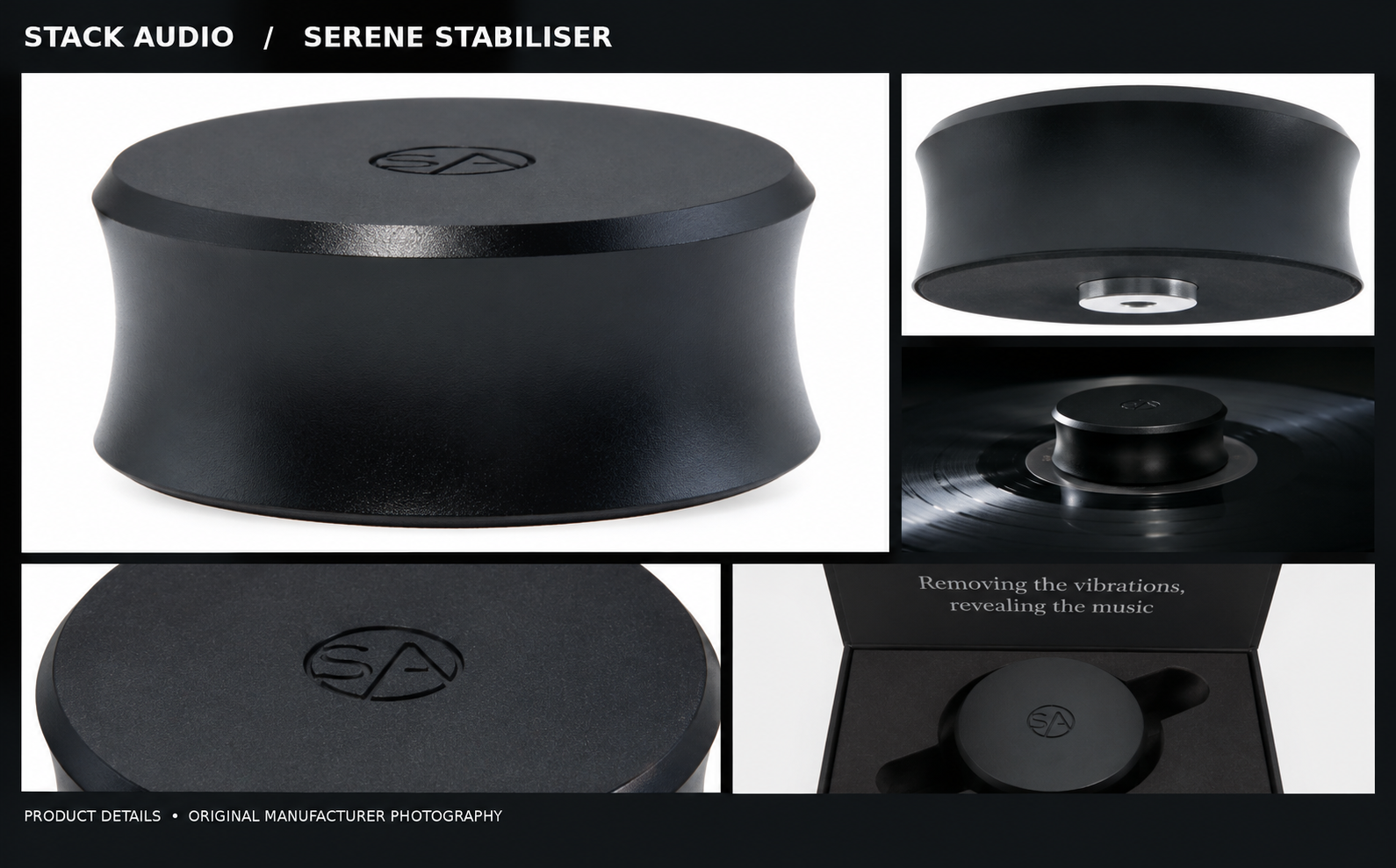
Traditional record weights often depend on mass to increase contact between the record and platter. Stack Audio instead employs a technology it calls Tension-Activated Particle Absorption, or TAPA.
The Stabiliser uses an aluminium body, a tensioned silicone membrane, and lightweight damping particles.
When placed over the spindle, the body rests on the record label while the central hub establishes tension in the membrane.
According to Stack Audio, that tension serves two purposes.
First, the membrane provides a means of dissipating vibrational energy. Second, it helps activate the particles within the assembly, allowing their movement and collisions to convert a portion of that mechanical energy into heat.
This is the underlying principle of particle damping, an established approach to vibration management, although its effectiveness depends on the implementation.
What I find particularly appealing is that the design doesn't require substantial mass.
Stack Audio offers two versions: a Standard model weighing 85 grams and a Long version weighing 95 grams. Both measure 77 mm in diameter, with heights of 25 mm and 29 mm, respectively.
For perspective, some conventional record weights weigh several hundred grams.
That makes the SERENE particularly interesting for Rega and suspended turntable owners who may be reluctant to introduce substantial additional loading.
It also explains why the Stabiliser shouldn't be confused with a record flattener. Although it applies gentle pressure to the label, correcting warped records isn't its primary function.
Two Different Methods, One Shared Objective
The Mat and Stabiliser aren't simply duplicates of the same technology.
The Mat uses compliant supports beneath the record to manage vibration through mechanical movement and damping. The Stabiliser employs a tensioned membrane and particle damping above the record label.
They address different parts of the mechanical relationship between the record and turntable.
The engineering is interesting, but the more important question is whether these approaches produce an audible benefit.
In my system, they did.
Listening on the Rega Planar 10: A New Opportunity
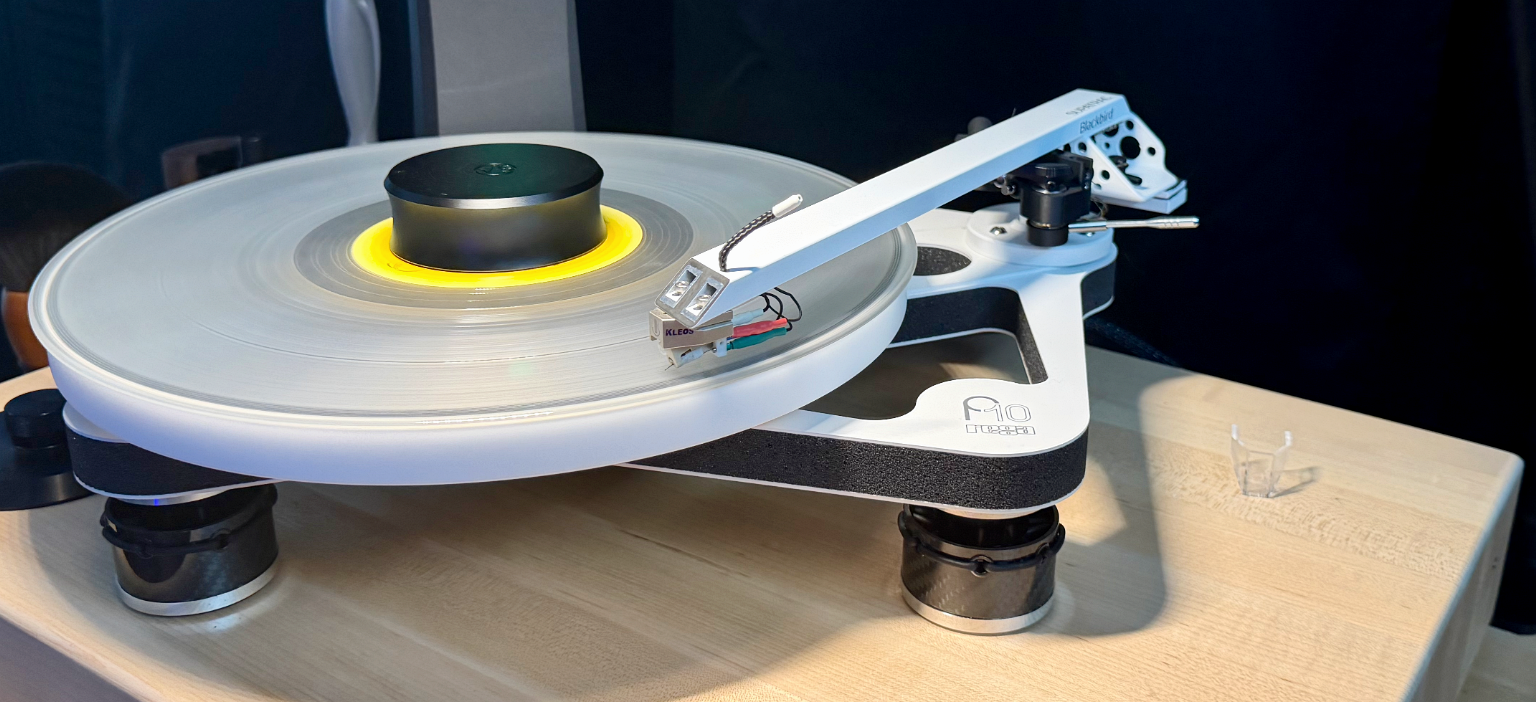
My analog system is built around a Rega Planar 10, now fitted with a SUPATRAC Blackbird tonearm and Lyra Kleos moving-coil cartridge. Phono amplification is handled by the Sutherland Dos Locos.
The distinction between my original and current tonearm configurations is important.
When I first evaluated the SERENE Stabiliser, the Planar 10 was equipped with its stock RB3000 tonearm. That review established my initial impressions of the Stabiliser, but the limitations of the tonearm setup prevented me from properly exploring the SERENE Mat.
The SUPATRAC Blackbird changed that.
With the additional setup flexibility, I could accommodate the Mat's thickness and revisit the Stabiliser under the new configuration.
For this review, I evaluated three arrangements:
- The SERENE Mat without the Stabiliser.
- The Stabiliser with the original Rega mat.
- Both SERENE products together.
These were subjective listening comparisons rather than controlled laboratory measurements. I didn't attempt to quantify vibration reduction or assign numerical scores to the differences.
Instead, I focused on familiar musical qualities: instrumental texture, bass articulation, spatial presentation, tonal balance, and whether the overall experience became more engaging.
The objective wasn't to prove that more accessories automatically produce better sound. It was to understand what each product contributed and whether their benefits remained complementary when combined.
The Music Behind the Impressions
When evaluating subtle changes in vinyl playback, I find it useful to draw on familiar recordings with very different musical characteristics.
Acoustic jazz can reveal spatial relationships and instrumental texture, while well-produced rock and electronic recordings provide opportunities to assess bass articulation, separation, and musical energy.
The following records from my collection illustrate the musical qualities I pay particular attention to when listening critically.
Miles Davis — Kind of Blue (Analogue Productions UHQR, UHQR 0004)
The acoustic instruments and natural spatial relationships on Kind of Blue make it an excellent reference for evaluating openness and fine detail.
On "So What," I listen for the separation between instruments, the texture of the double bass, and the way the trumpet and saxophones occupy their own spaces without losing the cohesion of the performance.
Fleetwood Mac — Rumours (Warner Bros., 9362-49793-5)
"Dreams" and "The Chain" offer two different perspectives on musical presentation.
The former is particularly useful for assessing vocal clarity, subtle percussion, and the relationship between instruments. The latter provides an opportunity to evaluate bass definition, dynamic energy, and whether improved control comes at the expense of musical drive.
Pink Floyd — Wish You Were Here (Columbia, PC 33453)
The atmospheric introduction to "Shine On You Crazy Diamond" is a revealing test of spatial presentation and low-level detail.
I listen for how individual sounds emerge from the background, how convincingly the soundstage develops, and whether the presentation remains natural rather than artificially exaggerated.
Daft Punk — Random Access Memories (Columbia, 88883716861)
"Give Life Back to Music" and "Giorgio by Moroder" are useful references for rhythmic precision, bass articulation, and the separation of densely layered instrumentation.
They're particularly helpful for determining whether greater perceived detail also contributes to a more engaging musical presentation.
Across these recordings, the qualities I value remain consistent: natural tonal balance, convincing instrumental texture, clearly defined bass, and a presentation that allows the music to breathe.
Those priorities informed how I approached the SERENE comparisons.
The SERENE Mat: Fine Detail Without Exaggeration
Replacing the stock Rega mat with the SERENE Mat brought a welcome improvement in the presentation of fine musical detail.
Subtle elements within familiar recordings became easier to distinguish, but without an accompanying increase in brightness or emphasis on the upper frequencies. Individual instruments sounded a little more clearly defined while retaining their natural tonal character.
The improvement was subtle, but meaningful. Rather than drawing attention to itself, the Mat allowed more of the recording's nuances to emerge without disrupting the balance I already enjoyed.
Bass Texture, Not Bass Quantity
Bass performance was another area where I heard a worthwhile improvement.
What stood out wasn't an increase in low-frequency output, but the character of the bass itself.
Notes seemed to have more texture, making it easier to appreciate their individual qualities rather than simply their weight.
I've always preferred bass that's articulate and controlled over bass that sounds impressive merely because there's more of it.
The SERENE Mat moved the presentation in that direction. It was a refinement rather than a dramatic change in tonal balance, but one I appreciated during extended listening.
A Welcome Sense of Liveliness
One concern with vibration-control accessories is that excessive damping can make music sound restrained, sacrificing energy in pursuit of greater control.
That wasn't my experience with the SERENE Mat.
The presentation retained its rhythmic drive and expressiveness, while the improvements in clarity and bass articulation made performances more involving.
The Mat seemed to strike a satisfying balance between control and musical vitality.
For me, that balance was among its most appealing qualities.

The SERENE Stabiliser: Revisiting an Old Favorite
My experience with the SERENE Stabiliser began before the SUPATRAC upgrade.
During my original review with the stock RB3000 tonearm, I was initially apprehensive about introducing a record stabiliser to the Rega Planar 10.
Rega's lightweight engineering philosophy doesn't encourage the use of substantial record weights, and I didn't want to compromise the turntable's operation in pursuit of an incremental improvement.
Fortunately, the SERENE's lightweight design proved straightforward to integrate.
During that evaluation, I noticed no obvious playback-speed instability or other operational problems after adding the Stabiliser. I did not conduct separate measurements of bearing load or motor strain.
But the real test was listening.
What I Heard During the Original RB3000 Evaluation
The first thing that stood out was a reduction in perceived background noise.
My Planar 10 was already impressively quiet, yet the Stabiliser seemed to create a deeper sense of stillness, allowing subtle musical information to emerge more clearly.
Bass notes appeared tighter and better articulated, while vocals and acoustic instruments benefited from greater clarity and presence.
But the most striking improvement was spatial.
Listening to Schubert's Sonata for Arpeggione and Piano in A Minor, D. 821, performed by Mstislav Rostropovich and Benjamin Britten, I was particularly impressed by the separation between cello and piano.
Their distinct tonal characters and positions within the recording became easier to appreciate, creating a greater sense of openness and dimensionality.
Michael Jackson's Thriller provided another useful perspective.
On "Billie Jean" and the title track, subtle percussion, layered vocals, and production details seemed more clearly resolved without sacrificing the music's rhythmic energy.
Not every change was entirely neutral, however.
On Jimmy Reed's I'm Jimmy Reed, the harmonica's occasionally piercing upper frequencies sounded somewhat less aggressive.
Personally, I welcomed the change because it made the recording more comfortable to enjoy at higher listening levels.
But I also recognize that some listeners might interpret that softening as a departure from the recording's original tonal character.
That distinction matters.
An accessory that makes a recording more enjoyable isn't necessarily reproducing it more accurately.
The SERENE Stabiliser impressed me because most of its contributions felt natural and complementary to the Rega's existing presentation. But I wouldn't suggest that every recording was affected identically or that all listeners would prefer the changes.
Returning to the Stabiliser with the SUPATRAC Blackbird
With the SUPATRAC Blackbird installed, I revisited the Stabiliser using the original Rega mat.
That allowed me to evaluate its contribution without simultaneously changing the record's supporting surface.
The familiar sense of openness remained, accompanied by welcome improvements in the definition of fine musical details.
Instruments appeared to have more breathing room within the soundstage, although I wouldn't characterize the change as a dramatic expansion of its dimensions.
The presentation felt slightly more composed and resolved, while retaining the musical character I knew from the Planar 10.
The improvement was incremental rather than transformative, but consistently welcome.
Importantly, this comparison confirmed that the Stabiliser had merits independent of the SERENE Mat.
And that made the next step particularly interesting.
Watch My Original SERENE Stabiliser Review
My earlier Vinyl Latte video documents the original evaluation with the Rega Planar 10 and stock RB3000 tonearm.
In that review, I explored the Stabiliser's lightweight design, vibration-control approach, and listening performance across recordings ranging from classical music and jazz to rock and blues.
That video focused exclusively on the Stabiliser.
The current article builds on that experience by introducing the SERENE Mat and examining how both products perform together following the SUPATRAC Blackbird upgrade.
Watch my original Stack Audio SERENE Stabiliser review, conducted with the Rega Planar 10 and stock RB3000 tonearm.
A Practical Advantage for Rega Owners
Beyond its sonic contribution, the Stabiliser has another advantage.
Unlike replacing the platter mat, adding the Stabiliser doesn't inherently change the height at which the record sits relative to the tonearm.
That makes it a straightforward accessory to evaluate without introducing another variable into the cartridge's playback geometry.
It's important, however, to understand what the Stabiliser isn't.
This isn't an accessory designed to force badly warped records flat. Anyone expecting that functionality should consider a different type of product.
Instead, the Stabiliser is intended to manage mechanical energy while adding relatively little mass.
For me, its combination of audible benefits and uncomplicated installation makes it an appealing option for a turntable like the Planar 10.
SERENE Synergy: Better Together
This was the comparison I'd wanted to make since my original Stabiliser review.
With the SUPATRAC Blackbird allowing me to accommodate the SERENE Mat properly, I could finally evaluate Stack Audio's two approaches to vibration management as a complete system.
After listening to each accessory independently, I consistently preferred using them together.
I call it SERENE Synergy.
The Mat's improvements in bass texture and musical energy complemented the Stabiliser's contribution to spatial openness and fine detail.
With both installed, the presentation felt more cohesive and satisfying than either accessory achieved independently.
Importantly, the combined effect wasn't simply twice the improvement.
Each product addresses a different aspect of the record's mechanical environment, and in my system their contributions appeared complementary rather than redundant.
What I appreciated most was how naturally the combination integrated into my system.
The Planar 10 retained its familiar character, the Lyra Kleos maintained its tonal personality, and the overall presentation remained natural and engaging.
These remain subjective listening impressions, not laboratory measurements demonstrating a particular reduction in vibration.
Results may differ depending on the turntable, cartridge, tonearm, and overall setup.
But the question that had remained unanswered during my original review finally had an answer.
For my system, using both SERENE products together delivered the most satisfying result.
And that made revisiting the Stabiliser worthwhile.
Before You Buy: Two Things That Matter
As much as I enjoyed the SERENE products, there are a couple of practical considerations worth understanding before placing an order.
Mat Thickness and Tonearm Height
The SERENE Mat is approximately 3 mm thick.
Depending on your existing platter mat, that may change the height at which the record sits relative to the tonearm.
Why does that matter?
Because cartridge geometry influences how the stylus contacts the groove.
Changing the record's playing height can affect vertical tracking angle and stylus rake angle. Depending on the cartridge and the magnitude of the change, those differences may influence playback.
Turntables with adjustable tonearm height make compensation relatively straightforward.
Rega owners may have a little more work ahead of them.
Many Rega tonearms don't offer convenient, continuously adjustable height, so spacers or shims may be necessary.
That limitation was central to my original SERENE experience.
With the stock RB3000 tonearm, I wasn't able to accommodate the Mat in a way that satisfied my setup requirements. The SUPATRAC Blackbird ultimately gave me the flexibility to explore the Mat properly.
I'm not suggesting that every Rega owner will need to replace a tonearm or modify their turntable.
The answer depends on the original mat thickness, cartridge, and tonearm arrangement. Spacers or other adjustments may be sufficient.
However, it's something I would investigate before purchasing.
There's also an important lesson here for anyone evaluating platter mats: changes in record height can themselves influence what we hear.
It's worth accounting for that before attributing every difference to the mat's vibration-control properties.
A mat should improve your listening experience, not introduce an avoidable setup problem.
Order the Correct Stabiliser Version
Stack Audio offers two Stabiliser configurations to accommodate different spindle arrangements.
The Standard version weighs 85 grams, measures 25 mm tall, and accommodates spindles extending up to 14 mm above the record.
The Long version weighs 95 grams, measures 29 mm tall, and accommodates spindle heights up to 23 mm.
Both have a diameter of 77 mm.
For proper operation, the Stabiliser's body needs to rest on the record label. If it remains suspended above the label because the spindle is too tall, it won't fit as intended.
This was also something I discussed in my original video, when compatibility with taller spindles was a potential limitation.
Stack Audio now offers the Long version to address a wider range of applications, although spindle heights above 23 mm are not currently supported.
A quick confirmation with Stack Audio before ordering is considerably easier than discovering a fitment problem after delivery.
These details aren't reasons to avoid the products. They're simply part of making an informed purchase.
Mat or Stabiliser: Which Should You Buy First?
If there's one question I expect prospective buyers to ask, it's whether they really need both products.
My answer depends on the turntable.
For most turntable owners, I'd start with the SERENE Mat.
In my listening, replacing the stock mat produced worthwhile improvements in fine detail, bass texture, and musical liveliness.
At £75, it also represents the less expensive way to explore Stack Audio's approach to vibration management.
If your turntable can accommodate the Mat without introducing significant setup complications, it's a sensible starting point.
For Rega owners, I'd take a slightly different approach.
Consider starting with the Stabiliser.
Having evaluated it with both the RB3000 and SUPATRAC Blackbird tonearms, I can say that it offered worthwhile benefits independently of the Mat.
It also has the advantage of being straightforward to install without changing the record's playing height.
That makes it an attractive first step, particularly if you're using a conventional Rega tonearm and would prefer not to install spacers or make other adjustments.
However, I want to make one distinction clear.
I'm not suggesting that the Stabiliser is automatically the better-sounding individual upgrade for every Rega owner.
The Mat produced worthwhile improvements in my system, too. My preference for recommending the Stabiliser first is based on its combination of audible benefits and ease of integration.
There is also a significant price difference to consider.
You can always add the Mat later if you're comfortable addressing the setup considerations.
And if your budget allows for both, that's ultimately the combination I prefer.
Neither accessory is essential, but together they delivered the result I found most convincing.
Are They Worth the Investment?
This is where I think it's important to maintain some perspective.
At the time of this review, Stack Audio lists the SERENE Mat at £75 and the Standard Stabiliser at £195, bringing the combined cost to £270. The Long Stabiliser is priced higher, at £210, bringing that combination to £285.
These are published UK prices, including VAT. Regional pricing and applicable charges may differ.

The Mat is the more accessible purchase, and at £75, I think it offers an interesting opportunity to experiment with a different approach to record support.
The Stabiliser is a more substantial investment.
At £195 for the Standard version, it deserves to be judged on its independent contribution rather than simply its ability to complement the Mat.
For me, its improvements in openness, instrumental definition, and overall presentation were worthwhile.
Whether those refinements justify the asking price will depend on the resolving ability of your system and how much you value incremental improvements.
The Rega Planar 10 is already an exceptionally capable turntable.
It doesn't require an aftermarket mat or record stabiliser to deliver excellent sound.
And I would never suggest that adding a couple of accessories is equivalent to upgrading a cartridge, correcting a poorly configured tonearm, or addressing a fundamental issue elsewhere in the playback chain.
Those decisions can have considerably greater consequences.
But once a system is properly configured and performing well, smaller refinements can become worthwhile.
That's where I see the SERENE products fitting.
They aren't a shortcut to great vinyl playback. They're accessories for listeners who already have a capable setup and want to explore whether more performance can be extracted from it.
In my experience, they delivered worthwhile improvements without fundamentally changing the sound I had worked to achieve.
Whether those benefits justify the expense will depend on your turntable, your priorities, and how much you value incremental gains.
I would encourage prospective buyers to evaluate them in their own systems whenever possible.
A positive result on my Planar 10 doesn't guarantee an identical experience elsewhere.
Final Verdict
The Stack Audio SERENE Mat and Stabiliser have earned a permanent place in my analog system.
But this review represents more than simply evaluating two accessories.
It's the conclusion of an experiment that began with my original SERENE Stabiliser review and remained unfinished until I upgraded the Planar 10's tonearm.
The Mat brought greater bass texture, clearer fine detail, and a welcome sense of musical energy.
The Stabiliser contributed greater spatial openness, improved instrumental definition, and a more composed presentation. My earlier evaluation also revealed occasional changes in perceived tonal balance, a reminder that even welcome improvements deserve careful consideration.
Together, they delivered the most satisfying result.
Neither product is essential to enjoying excellent vinyl playback, and both deserve consideration within the context of your turntable's design and setup.
Mat thickness, tonearm geometry, and spindle compatibility are practical factors that shouldn't be overlooked.
My buying recommendation remains straightforward: for most turntables, start with the SERENE Mat. For Rega owners seeking an uncomplicated first upgrade, the Stabiliser is an appealing alternative.
And if your budget and setup accommodate both, that's the combination I would choose.
Ultimately, the SERENE products demonstrate that worthwhile improvements don't always require a fundamental change to an already accomplished analog system.
Sometimes, the most rewarding refinements are the ones that let the music speak a little more clearly.
And for me, that's where the Stack Audio SERENE combination succeeds.
Learn More About Stack Audio SERENE
For additional technical information, compatibility details, and current pricing, visit Stack Audio's official product pages.
Explore the silicone platter mat, its four tuned sprung supports, and turntable compatibility.
Learn more about the lightweight record stabiliser, its TAPA vibration-damping technology, and available spindle-height options.
Equipment Used: Rega Planar 10 turntable, SUPATRAC Blackbird tonearm, Lyra Kleos moving-coil cartridge, and Sutherland Dos Locos phono preamplifier. Original Stabiliser evaluation conducted with the stock Rega RB3000 tonearm.
Manufacturer: Stack Audio
Review Disclosure: Stack Audio provided the SERENE Mat and Stabiliser to Vinyl Latte for evaluation. This arrangement did not influence our findings or conclusions. Vinyl Latte retained full editorial independence, and Stack Audio had no input into the content of this review, nor was the article submitted to the company for review or approval prior to publication.



Comments ()